
- Editorial links are links an editor or author adds to their own content because it helps their readers. Nobody paid for them and nobody traded for them. That's why they're the links Google's spam policies leave alone.
- Quick test: if money, a product, or a link swap got you the link, it isn't editorial. Google asks for paid links to carry rel="sponsored" or rel="nofollow" (Google Search Central).
- How to earn them, in 7 steps: find the pages that already rank and get cited by AI for your topic, give the editor a reason to add you, reach the right person, pitch in a few lines, follow up twice, turn old mentions into links, and check that the link stays.
- Why they still matter: in Ahrefs' study of 1 million US keywords, referring domains still correlate with rankings at 0.255 (Ahrefs). In AI answers, 85% of brand mentions come from other sites, mostly lists, comparisons, and reviews (AirOps, October 2025).
- Disclosure: GEOboom is our product. We show where it runs steps of this process and where it doesn't. Facts checked on November 24, 2026.
What is an editorial link?
An editorial link is a link that the person who runs a page chose to add. They added it because it makes their content better for their readers. You didn't pay for it, you didn't write the page, and you didn't promise a link back.
A simple example. A writer updates their "best project management tools for agencies" list. Your tool fits the list, a reader would want to know about it, and you sent the writer a short note with the facts. The writer adds your tool with a link. That's an editorial link.
Two things people often mix up:
- Editorial is about who decided and why. Editorial links usually pass ranking credit. Some sites mark every outbound link nofollow. A link there can still be the editor's choice, it just carries less SEO weight.
- Every editorial link is a backlink, but not every backlink is editorial. A link in a directory you signed up for, a footer credit, or a post you paid for is a backlink. It isn't editorial.
In practice, most editorial links come from four places: articles that cite a source (a stat, a study, a quote), lists and comparisons ("best X" pages, "X vs Y"), resource pages and guides, and news or industry coverage.
Editorial or not: a quick test
A link is editorial when the site owner decided on the merits and got nothing for it. Google's link spam policy (updated November 23, 2026) draws the same line from the other side. It lists "buying or selling links for ranking purposes," "excessive link exchanges," and "links with optimized anchor text in articles, guest posts, or press releases" as spam. Paid links are fine when they're marked sponsored or nofollow, and which attribute a live link carries is free to check.
| Link type | Who decided | Editorial? | What Google asks |
|---|---|---|---|
| A site cites your data or page on its own | The editor | Yes | Nothing |
| You pitch, the editor adds you, no payment | The editor | Yes | Nothing |
| An old mention of your brand gets a link after you ask | The editor | Yes | Nothing |
| Paid placement, sponsored post, or paid insert into an old article | Your money | No | Mark it sponsored or nofollow |
| A product sent in exchange for a review with a link | Your product | No | Same as paid: mark it |
| Link exchange ("I'll link to you if you link to me") | A deal | No | Excessive exchanges are listed as spam |
| Guest post with a link to you | You wrote it, the editor approved it | Partly | Keep anchors natural. Optimized anchors in guest posts are listed as spam |
| Private blog network (PBN) | You own both sides | No | Link spam |
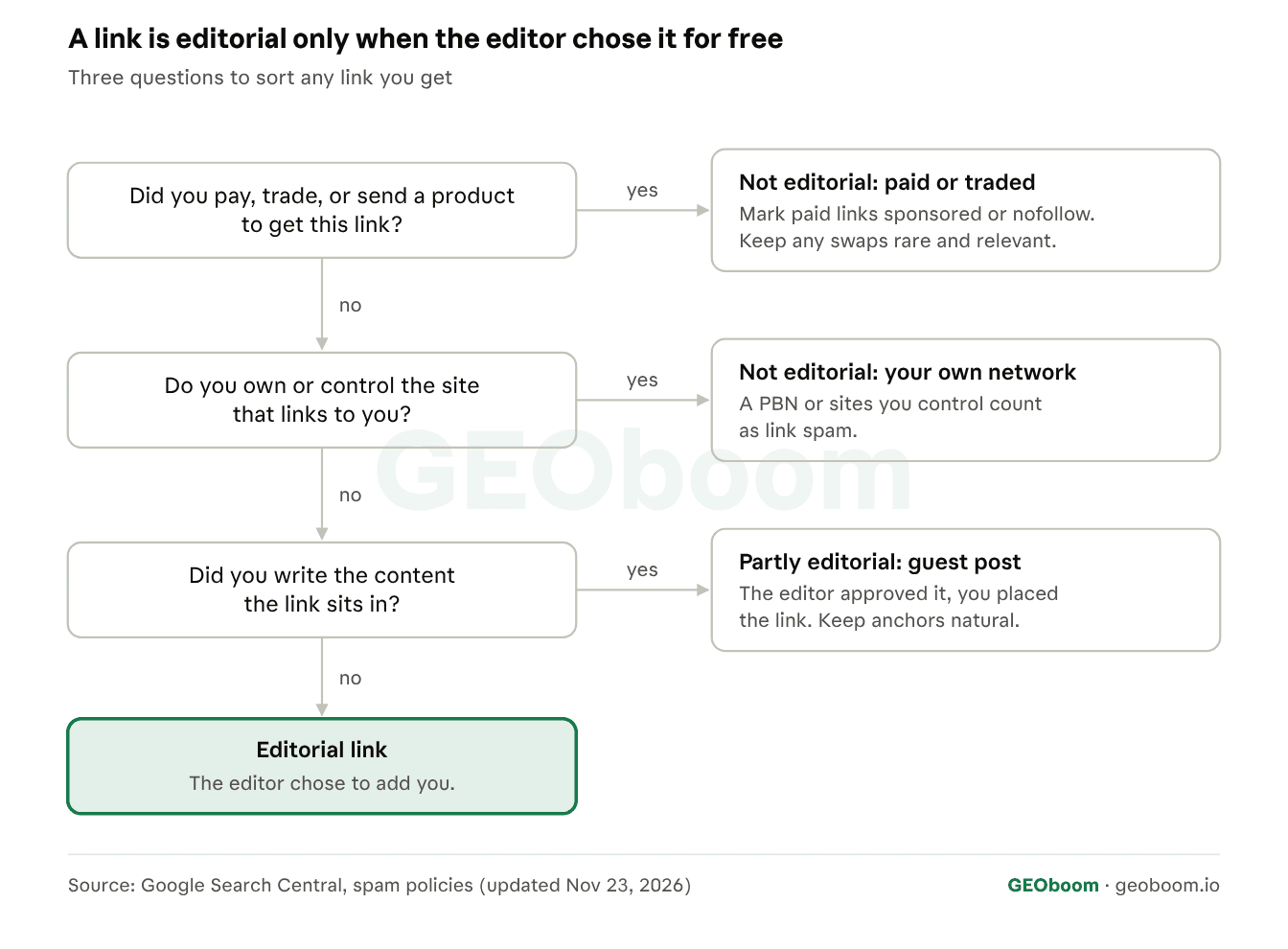
Two honest notes. First, a paid or traded mention can still be worth having: real readers see it, and it can bring visits. It just isn't editorial, so call it what it is and mark it. Second, Google doesn't publish a number for "excessive." It names excessive swaps and partner pages made only to cross-link. A swap program across dozens of sites fits that. An occasional swap between two relevant sites is a judgment call, so keep it rare and keep it relevant.
Why editorial links still matter for SEO and AI answers
Links count for a bit less than they used to, but they still count. Ahrefs checked the top 1 million US keywords and found that the number of referring domains correlates with rankings at 0.255. In their 2019 study it was 0.29, with a different method, so the drop is approximate (Ahrefs, January 2025, updated August 2026).
AI answers lean on the same kind of pages. AirOps looked at 21,311 brand mentions in GPT-5, Claude Sonnet 4.5, and Perplexity answers. 85% came from other sites, only 13.2% from the brand's own domain, and nearly 90% of those outside mentions sat in listicles, comparisons, and reviews (AirOps, October 2025). AirOps sells an AI content platform, so read it as a vendor study.
The mention itself matters, too. In Ahrefs' study of 75,000 brands, mentions of a brand on other sites correlated with its visibility in Google AI Overviews at 0.664. Backlinks correlated at 0.218 and referring domains at 0.295 (Ahrefs, May 2025, updated April 2026). An editorial link from a "best X" list gives you both: the link for rankings and the mention for AI answers. Ahrefs sells an AI tracker, Brand Radar.
Correlation isn't proof of cause. But both studies point the same way: get your brand named, with a link, on the pages people and AI already read.
How to earn editorial links: 7 steps
The short version: go where your buyers already read, bring the editor something useful, and make saying yes easy. Here's the process step by step.
Step 1. Find the pages that already rank and get cited for your topic
Write down the questions your buyers ask, like "best CRM for small agencies" or "Ahrefs vs Semrush for startups." Search them in Google and in ChatGPT, Perplexity, or Gemini. Save every page that shows up, especially "best X" lists, comparisons, and reviews.
Check both places. In Ahrefs' study of 863,000 search results, only 37.9% of the URLs cited in AI Overviews also appeared in Google's first 10 results for the same query (Ahrefs, March 2026). So a page can matter to AI answers without ranking on page one.
Then clean the list. Remove pages that are off-topic, pages run by your competitors, and pages that already mention you. Put the pages that rank and get cited at the top.
Step 2. Give the editor a reason to add you
Editors add what helps their readers. Bring one of these:
- You fit the page. Your product meets the list's own criteria, and you can show it with a price, a feature, or a review score.
- A fresher fact. The page quotes a 2019 stat, and you have a newer source.
- Original data. A small survey, your own usage numbers, or a benchmark.
- A free tool or template the page's readers would use.
- An expert quote for a piece they're updating.
No reason, no link. A pitch that only says "please add us" rarely works.
Step 3. Reach the person who edits the page
Write to the author or the editor of that page, not to info@ or a contact form. Look at the byline, the site's About and team pages, and LinkedIn; a free finder turns a name into an address. If you can't find the author, the content lead or the site owner is the next best choice.
Step 4. Pitch in a few lines
Say which page you read, what you suggest adding, and why it helps their readers. Add a ready-to-paste blurb in the page's style, so the editor doesn't have to write anything. Keep the whole email short enough to read on a phone. Our outreach email templates cover the first email for a listicle, a mention request, an unlinked mention, and a broken link.
Here's what that looks like for a made-up rank tracker pitching a "best rank trackers for agencies" list:
Subject: A pick for your "best rank trackers for agencies" list
Hi [Name],
I read your list of rank trackers for agencies. It's one of the few that compares client reporting, which is what agencies ask about most.
Rankloop might fit as a pick. It tracks keywords for every client in one dashboard, and white-label reports start at $49 a month. Here's a blurb in your list's style, in case it helps:
"Rankloop: best for agencies with many small clients. One dashboard for every client's keywords, white-label PDF reports, from $49 a month."
Happy to send a login so you can test it first.
Thanks, [Your name]
It names the page, shows why the product fits, hands over a blurb, and asks for nothing the editor would have to justify. There's no link request and no anchor text. If the editor adds you, they'll link on their own terms.
Step 5. Follow up twice
Follow-ups roughly double your replies. In Hunter's data on 31 million emails sent in 2025, sequences of three messages got a 6.8% reply rate against 3.3% for a single email (Hunter, State of Email Outreach 2026). Send two short follow-ups a few days apart, in the same thread, then stop.
A good follow-up is shorter than the first email and adds no pressure:
Hi [Name], just checking this didn't get buried. If the list isn't up for an update soon, no worries. The blurb above is yours to use whenever it fits.
Step 6. Turn existing mentions into links
Some editorial links are already half done. Search for pages that name your brand without a link (this free tool lists them), and ask the editor to add one. Look for links to your old pages that now return 404 (a free crawl turns them up), and ask to point them to the live page. Both are easy yeses, because the editor already chose to mention you.
Step 7. Check that the link stays
Links disappear. Pages get updated, lists get trimmed, sites move. Check each link you earned on a schedule, and look at more than the URL: is your brand still named, and is it still in the same place on the list? If it drops, write to the same editor in the same thread, while they still remember the deal.
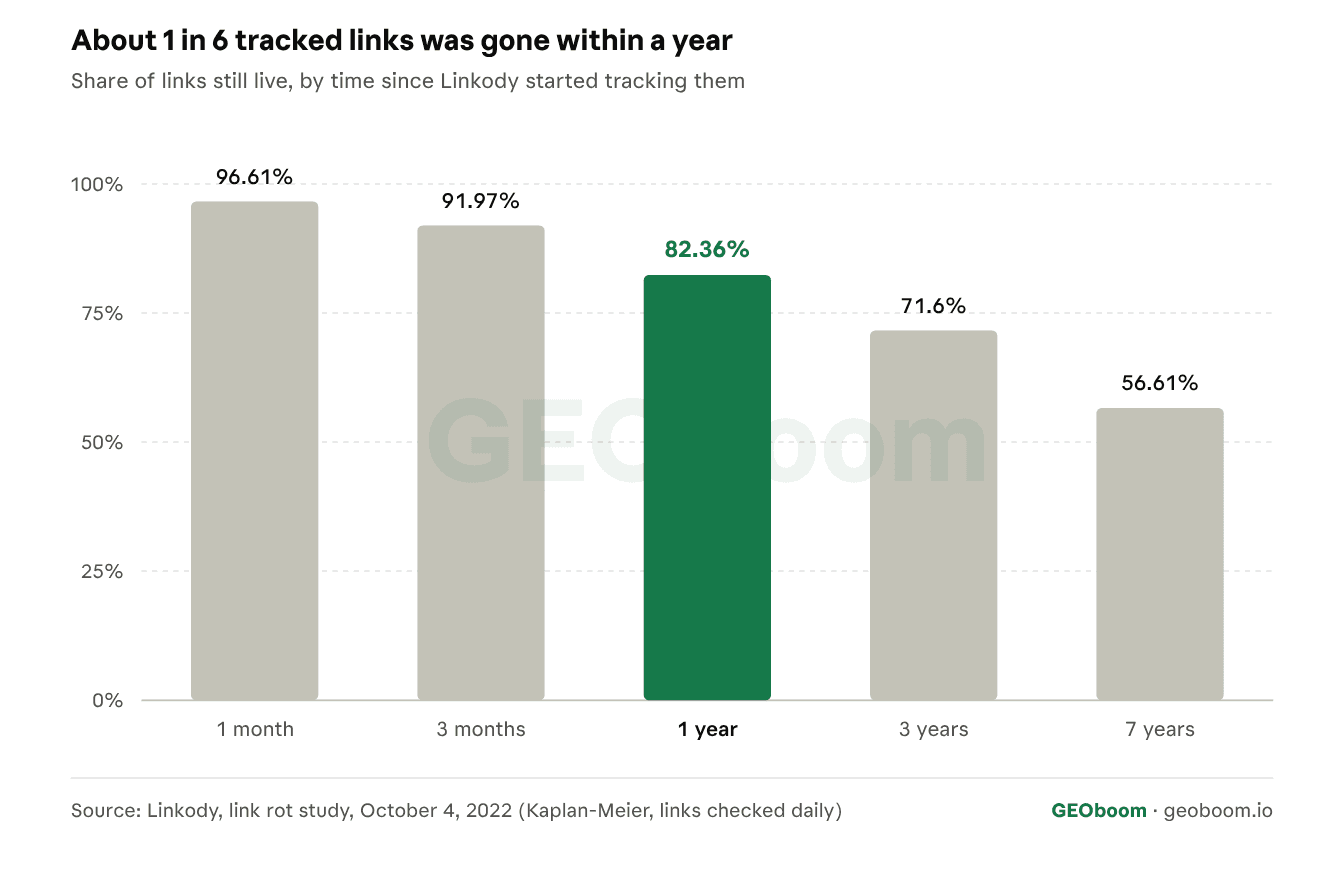
The data comes from Linkody's link rot study of links its users track, checked every 24 hours. Linkody sells link monitoring. The most common reason a link was lost: the site removed it from the content.
Mistakes that cost you editorial links
- Pitching pages you don't fit. If your product doesn't meet the list's criteria, a better email won't fix it. Pitch fewer pages, closer to your offer.
- Asking for a specific anchor text. Optimized anchors are exactly what Google's spam policy names, and this free tool shows the mix you already have. Let the editor word the link.
- One email for 500 sites. Editors spot a template in the first line. Name the page and say what you read on it.
- Hiding a payment. If you paid, ask for sponsored. An unmarked paid link is a risk for both sites.
- Counting replies as links. A reply or an offer isn't a link yet. Track what actually went live, and check it later.
When the editor asks for payment
Expect it. In Mentiohunt's data on 5,217 prospects contacted from July to November 2026, 377 of the 719 sites that replied asked to be paid. That's 52%. Only 8% proposed a link exchange (Mentiohunt, updated November 10, 2026). Mentiohunt sells outreach too, so it's a competitor of ours, but its numbers are the freshest we found.
A payment request doesn't end the conversation. You have three honest options:
- Decline politely and keep the door open. Say you don't pay for placements, and offer something else that helps their readers: fresh data, a quote, or an update to an outdated line.
- Pay, and treat it as what it is. A paid placement is an ad. Ask for it to be marked sponsored or nofollow, as Google asks. Real readers still see your name on the page.
- Swap only when it's relevant and rare. If the other site fits your audience, a one-off swap can work. Don't make it a program (see the test above).
Whatever you choose, don't call a paid link editorial in your reports. You'll make better decisions if you track earned and paid placements separately. For reply wording, see the "they ask for payment" template in our outreach email templates.
How GEOboom runs this process
GEOboom is link building and mention outreach to the pages AI answers already cite. It runs steps 1, 3, 4, 5, and 7 of this guide. Step 2, the reason to add you, is still yours: GEOboom doesn't create data, tools, or quotes for you, and it doesn't do digital PR with journalists.
Here's what it does at each step:
- Step 1, finding pages. Connect your AI visibility tracker, or give GEOboom the prompts your buyers ask. It pulls the pages AI answers cite, can add pages by keyword, and reads each one against your site. Off-topic pages, competitors' pages, and pages that already mention you are filtered out for free. The best pages come first.
- Step 3, finding the person. It finds verified contacts at 90%+ of sites: the editor, the author, or the content lead, up to 3 per site.
- Steps 4 and 5, pitch and follow-ups. Personal emails and follow-ups go out from GEOboom's own warmed-up inboxes. The first emails go out the day your account opens.
- Replies. Each reply comes with the site's numbers (traffic, top-10 keywords, spam score) and a drafted answer. You approve or skip each offer. Free inclusions and paid offers come in the same inbox, and you decide which to take. When you pay a site, you pay it directly, and GEOboom takes no cut.
- Step 7, keeping the link. GEOboom checks every live placement once a day: the text of the mention, its place on the list, the link, and the attribute. If it drops, GEOboom writes to the editor in the same thread right away and tells you. In one case, a mention dropped during a post update and was back the next day, with zero minutes from the client.
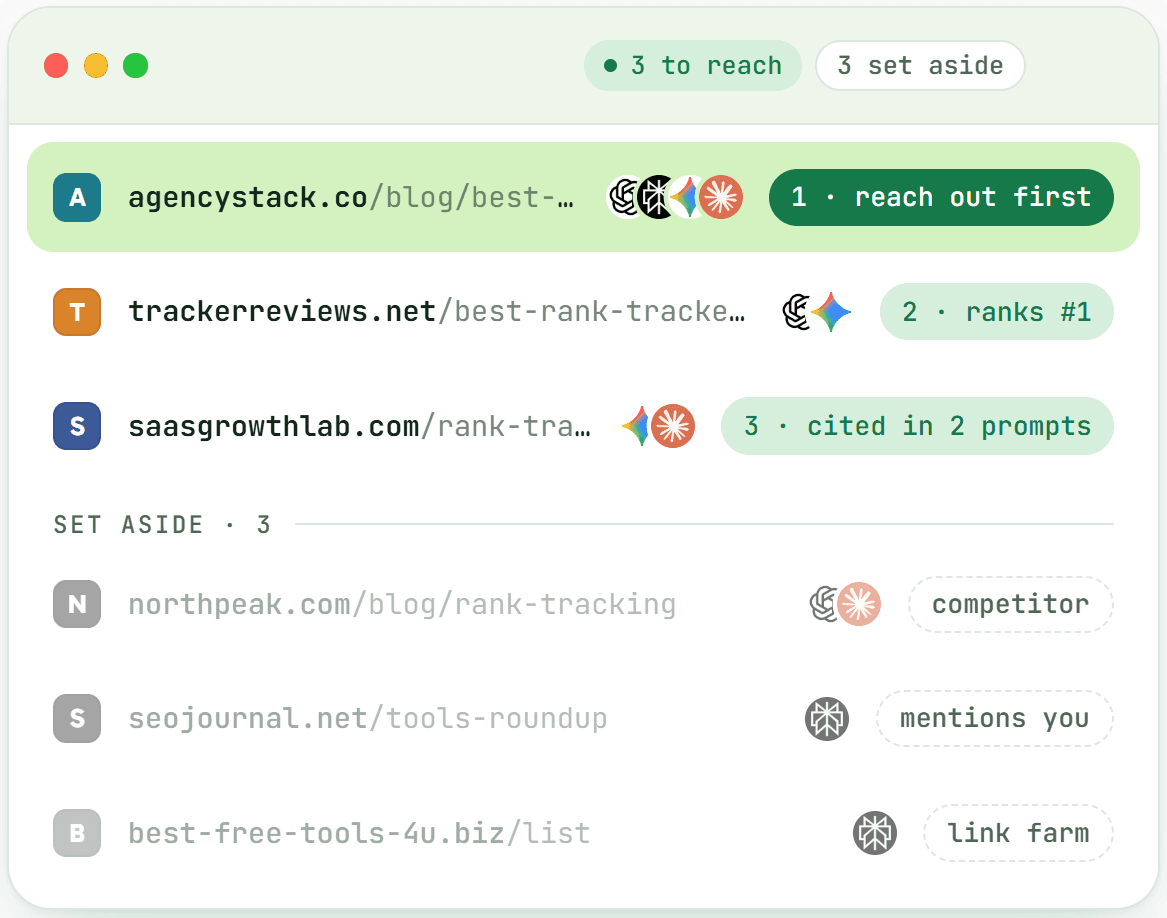
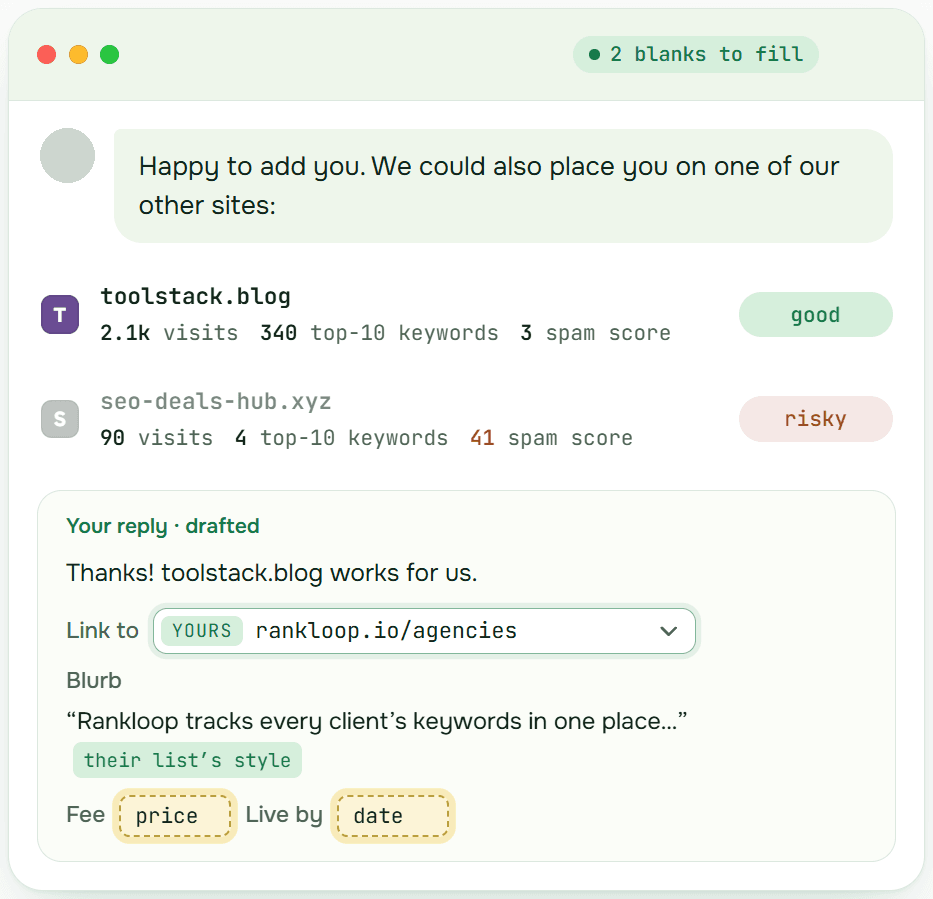
Pricing starts at $150 a month for 2–8 placements a month. Setup takes about 10 minutes, then about 2 hours a month to decide on offers. In one campaign for an IT services company, 825 URLs became 215 publishers and 30 offers in 10 days.
Want to see it on your own pages? Request a free trial.
Editorial links: FAQ
What is an editorial link?
An editorial link is a link a site owner or editor adds to their content because it helps their readers, with no payment or trade involved. A news site citing your study, or a "best X" list adding your product after a pitch, are both editorial links.
Are backlinks still relevant in 2027?
Yes, though less than before. Ahrefs found referring domains correlate with rankings at 0.255 across 1 million US keywords, down from 0.29 in 2019. For AI answers, mentions on other sites matter more than the link alone, and editorial links from lists and reviews give you both.
Is buying backlinks illegal?
For search, it's a policy question. Google's spam policies count buying links that pass ranking credit as link spam. A paid link marked sponsored or nofollow is allowed. Some countries also have ad disclosure rules, so check yours.
Are editorial links dofollow?
Usually, but not always. "Editorial" describes who chose the link. The attribute is a separate question. Some sites mark every outbound link nofollow. Those links pass less ranking credit, but readers still see your name.
What type of links are best for SEO?
Editorial links from relevant pages that rank or get cited for your topic. A link from a "best X" list your buyers read beats many links from unrelated sites. Paid links can bring visits, but they should be marked, and marked links don't pass ranking credit.
How do I get editorial links for free?
Find the pages that already rank and get cited for your topic, give the editor a real reason to add you, and pitch the author directly. Ask for links on existing mentions and fix broken links to your site. The process above needs time and no budget.
How this guide was prepared
Written by Oleksii Andrusenko, Head of Marketing at GEOboom and the CEO of GrowPad. Reviewed by Artur Briugeman, CTO of GEOboom. We checked Google's spam policies and link attribute docs, and opened every study cited here on November 24, 2026. Where a study comes from a company that sells SEO or outreach software, we say so next to the number. GEOboom is our product, and the GrowPad case linked above is a GEOboom client case.
Related
- 12 Listicles and Mentions Outreach Email Templates
- Brand Mentions vs Backlinks in AI Search: 15 Studies (2026)
- 8 Best Listicle Link Building Services and Tools in 2026
This guide is written by GEOboom, outreach software for getting your brand mentioned on the pages AI answers cite.