
AI referral traffic made up 0.32% of all website visits in January to April 2026, SE Ranking found across 101,574 sites. That's about 1 visit in 312. Other studies put it between about 0.2% and 1.08%, depending on the sites they track.
- Google still sends far more. For every 100 visits from Google organic search, AI assistants sent 1.25 in March to August 2026, in SEOcrawl AI's data for the same 3,099 sites. Ahrefs found Google sends 190 times as much as ChatGPT.
- ChatGPT sends most of it. Its share of AI referrals runs from 62.6% to 96.3% across six studies. On B2B sites Claude does much better than average: 18.5% in Goodie's panel.
- It's growing, in jumps. AI visits went from 0.53 to 1.52 per 100 Google visits between March 2025 and August 2026. A big jump came after May 7, 2026, when ChatGPT started showing clickable brand links in its answers.
- AI visitors stay longer. An average session from AI lasted 9 minutes 19 seconds, against 5 minutes 33 seconds from organic search. The medians were 2 minutes 24 seconds and 1 minute 53 seconds (SE Ranking).
- Whether they buy more depends on the data. AI visits to US retail sites converted 90% better than other traffic in September 2026, Adobe reported. A peer-reviewed study of 973 online stores found ChatGPT visitors converting worse than most channels in 2024 to 2025.
- Many answers send no click at all. Only 6.8% of US ChatGPT answers included a link to a source in May 2026 (Similarweb). After using an AI tool, the site people visited most often next was Google (Datos).
AI clicks are few, and in most 2026 studies each one is worth more than an average visit. Much of what AI does for a brand happens in the answer itself, so being named there, and on the pages it cites, matters more than the clicks it sends.
Each study counts differently. We show who ran it, what it counted, and when, next to every number.
How much traffic do AI assistants send to websites?
Between 0.2% and 1.1% of all visits, depending on whose sites a study tracks. Broad panels land at 0.3% to 0.4%: SE Ranking measured 0.32% across 101,574 sites in January to April 2026, and SEOcrawl AI measured 0.36% across 3,949 sites in March to August 2026, with 0.42% in August alone.
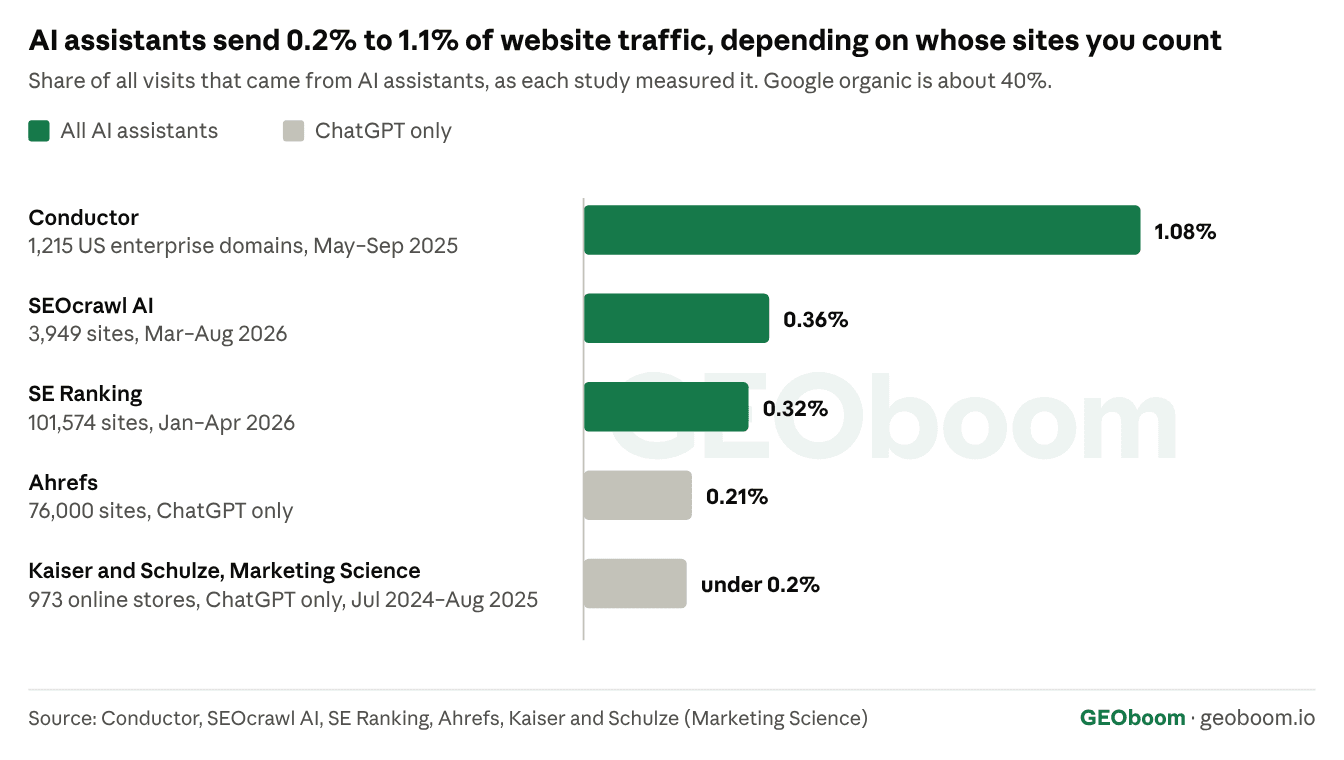
- Big brands see more. Conductor's panel of US enterprise domains reads highest. Its information technology sites got 2.80% of their traffic from AI.
- Online stores saw less in 2024 to 2025. In the Marketing Science study, ChatGPT's share of store traffic was about 200 times smaller than Google organic search's.
- Publishers see under 1%. That's what Microsoft Clarity found on more than 1,200 publisher and news sites in 2025.
None of these numbers include clicks from Google's AI Overviews or AI Mode. Google Analytics files those under organic search.
How does AI referral traffic compare with Google?
Google organic search still sends about 80 to 190 times as many visits as AI assistants. The four studies below count it in different ways, so read each ratio with its method.
| Study | What they found | How they counted |
|---|---|---|
| SEOcrawl AI, March to August 2026 | 1.25 visits from AI assistants for every 100 from Google organic (0.70 a year earlier) | GA4 sessions from AI assistants against Search Console clicks, the same 3,099 sites every month |
| Marie Haynes, 12 months of data, published October 2026 | 0.73 visits from all AI tools for every 100 from Google organic, 0.62 from ChatGPT alone | GA4 sessions on 100 sites of different sizes |
| SE Ranking, January to April 2026 | Organic search 42.75% of all traffic, AI 0.32%, about 134 times less | Google Analytics data from 101,574 sites |
| Ahrefs, February 2026 | Google 39.98% of all traffic, ChatGPT 0.21%, about 190 times less | Ahrefs Web Analytics on 76,000 sites, period not given |
Conversions tell the same story. AI visitors convert better in some studies, but in Haynes' data Google organic still brought 964 conversions against 36 from all AI tools combined, 27 times as many.
Usage doesn't close the gap. Ahrefs estimates ChatGPT handles about 12% as many search-like queries as Google, yet Google sends 190 times as much traffic to websites. Ahrefs' explanation: Google sends people to websites, and ChatGPT keeps them in the conversation.
Which AI assistants send the most traffic?
ChatGPT, in every study. Its share of AI referrals runs from 62.6% to 96.3%, and the panel decides where in that range a study lands.
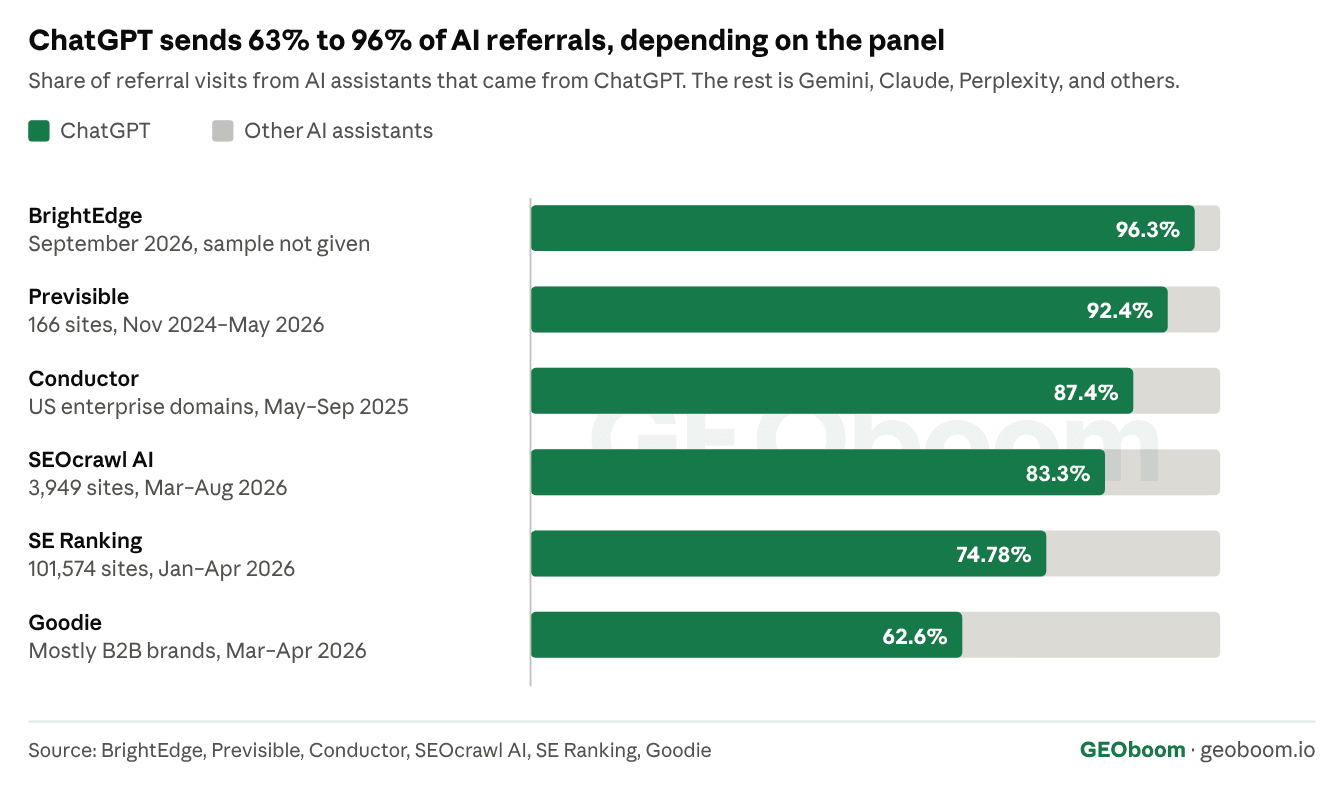
Who comes second depends on the sites:
| Study | Gemini | Claude | Perplexity | Copilot |
|---|---|---|---|---|
| SE Ranking, Jan–Apr 2026 | 11.56% | 2.62% | 7.23% | 3.51% |
| SEOcrawl AI, Mar–Aug 2026 | 6.0% | 3.7% | 4.7% | 2.1% |
| Goodie, Mar–Apr 2026, mostly B2B | 10.6% | 18.5% | 7.3% | 4.0% |
| BrightEdge, Q1 2026, before its July revision | 11.6% | 2.3% | 4.6% |
- Claude grows fastest on business sites. In Goodie's panel its share went from 1.4% in mid-2025 to 18.5%. Previsible counted 133 Claude sessions in November 2024 and 8,528 in May 2026, and Claude passed Perplexity there in March 2026.
- Perplexity is shrinking. At Previsible it's down 61% from its March 2025 peak. At SEOcrawl AI its share fell from 13.1% to 4.7% in a year.
- Copilot is small and falling. Previsible saw it drop 96% from its August 2025 peak.
The range comes from the panels. Goodie's is mostly B2B brands and averages each brand's share, so a small brand with many Claude users counts as much as a big one. BrightEdge doesn't disclose its sample and revised its history in July 2026.
Is AI referral traffic growing?
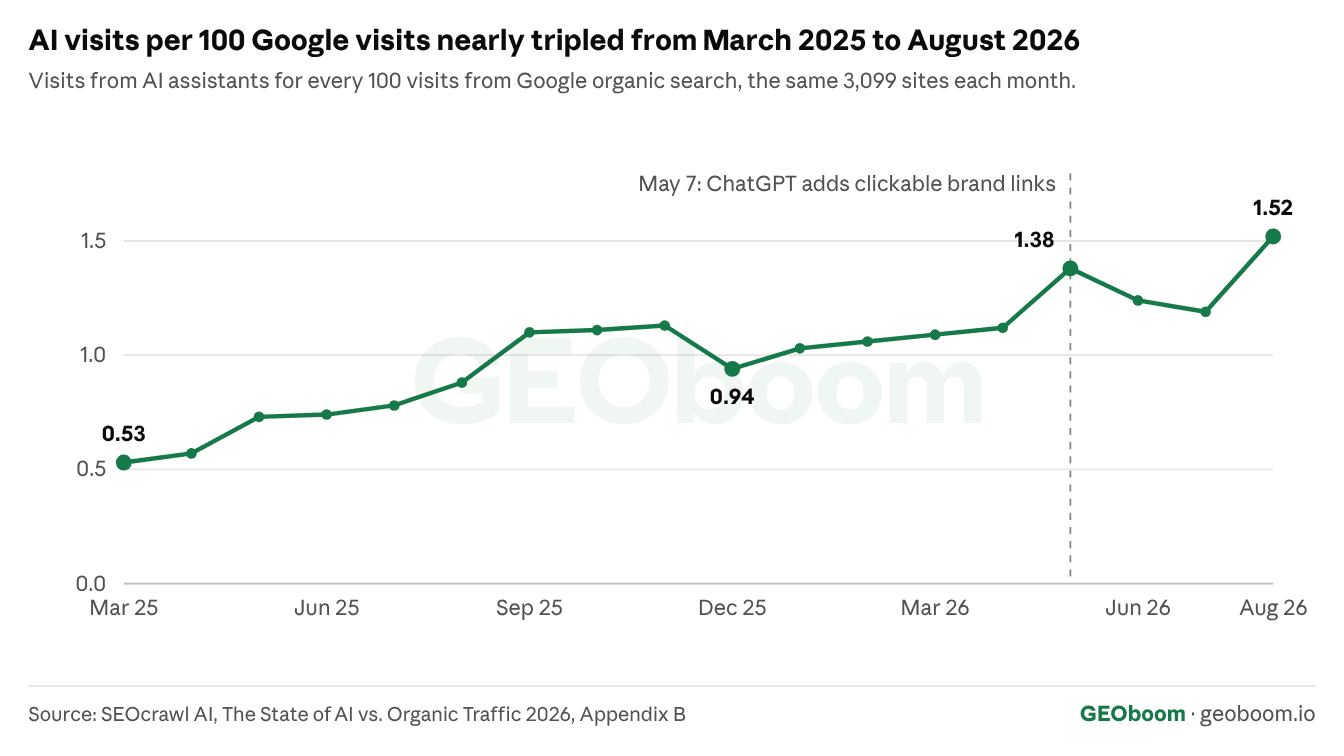
Yes, in jumps. On the same 3,099 sites, visits from AI assistants rose from 0.53 to 1.52 for every 100 Google organic visits between March 2025 and August 2026 (SEOcrawl AI). Over that time, AI sessions grew 92% and Google clicks fell 14%, so both moves pushed the ratio up.
- Since 2024. AI's share of all traffic went from 0.02% in 2024 to 0.24% in 2025 and 0.32% in 2026, about 16 times, at SE Ranking. It peaked at 0.35% in October 2025, dipped through December, and recovered.
- Year over year. AI sessions grew 44.6% from March to August 2025 to the same months of 2026, and grew on 57.6% of sites (SEOcrawl AI). Worldwide, AI platforms sent 770.7 million referral visits a month from June 2025 to May 2026, up 117.4% on the year before (Similarweb).
- ChatGPT alone. US referrals from ChatGPT grew 206% from January 2025 to January 2026 (Semrush). On Previsible's 166 sites, monthly ChatGPT sessions went from 47,606 in November 2024 to 610,910 in May 2026.
- Not every site grows. On Marie Haynes' 100 sites, ChatGPT sessions stopped growing fast in August 2025 and fell after that. Previsible saw ChatGPT drop from 448,412 sessions in October 2025 to 213,345 in November.
Several of these jumps and drops line up with changes to ChatGPT: GPT-5 in August 2025 in Haynes' data, a likely model change in November 2025 in Previsible's, and clickable brand links in May 2026 (next section). A single month says little on its own.
Why did ChatGPT referrals jump in May 2026?
ChatGPT started linking brand names. On May 7, 2026, it began showing clickable brand links inside its answers, where before most source links sat in footnotes or follow-up suggestions. In Similarweb's desktop panel, ChatGPT referrals rose 157.7% from the week before to the week after, and referrals to homepages rose 354.7%.
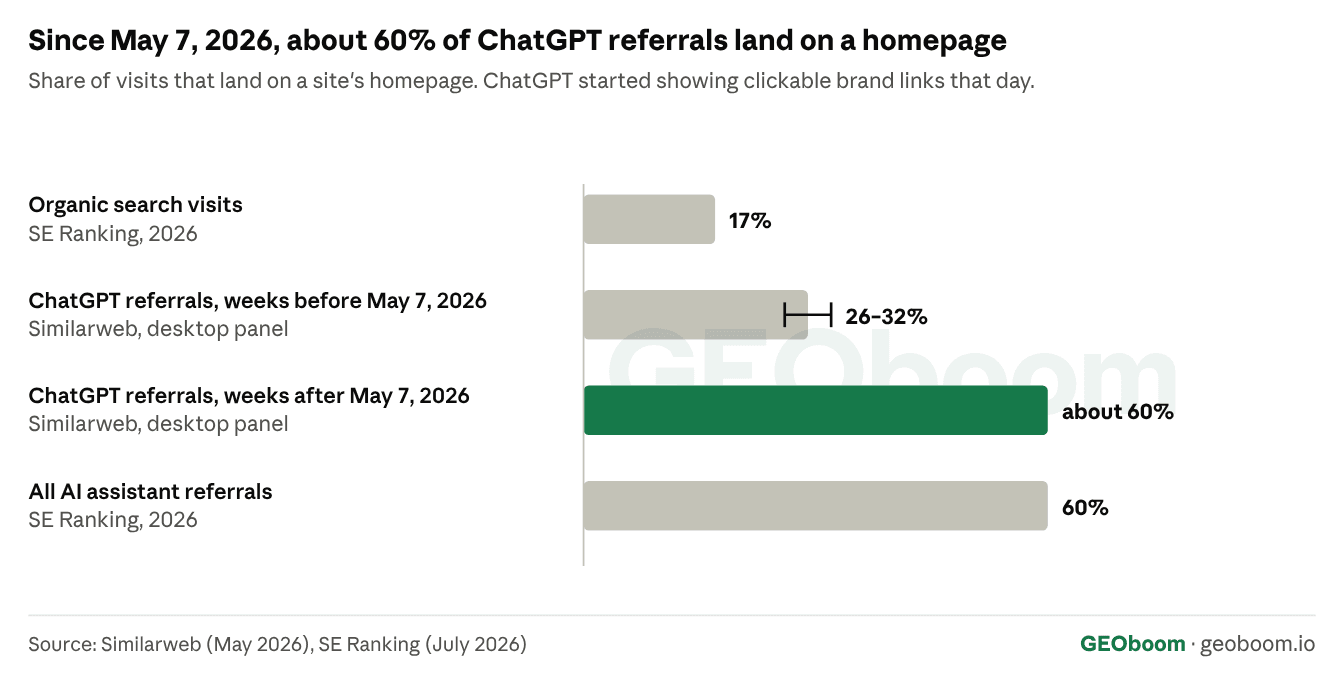
- The change stuck. The homepage share stayed around its new level in the weeks after (Similarweb). In SE Ranking's data, ChatGPT's share of all referral traffic went from 0.23% in April to 0.32% in May, up 36.7% in one month and above its October 2025 peak.
- Visitors browsed more. Pages per visit went from 3.8 to 4.7 and time on site from 3.5 to 3.9 minutes, the week before against the week after (Similarweb).
- A mention can now bring the visit. When ChatGPT names a brand, the name can be a link to its site. SE Ranking calls the new link format the strongest explanation for May's jump.
Is AI referral traffic higher quality?
Visitors from AI stay longer in nearly every study. Whether they buy more depends on the kind of site and the year of the data.
Engagement
- Longer sessions. An average session from AI lasted 9 minutes 19 seconds, against 5 minutes 33 seconds from organic search, across 101,574 sites. The medians were 2 minutes 24 seconds and 1 minute 53 seconds, so a few long sessions pull the average up (SE Ranking).
- On B2B sites. Average engagement time from ChatGPT, Gemini, Claude, and Perplexity ran 55 to 62 seconds, against 44 seconds from Google organic, in Goodie's panel. Each assistant had only 555 to 4,340 sessions there, so treat these as rough.
- In retail. In September 2026, AI visitors to US retail sites spent 73% more time on site, viewed 25% more pages, and added to cart 53% more often than other visitors (Adobe).
Conversion
| Study | Sites | AI visitors | Comparison |
|---|---|---|---|
| Marie Haynes, 12 months of data, published October 2026 | 55 sites that track conversions | ChatGPT: 13.8% | Google organic: 3.02% |
| Microsoft Clarity, one month in 2025 | 1,200+ publisher and news sites | All AI: 1.66% sign-ups, 1.34% subscriptions | Search: 0.15% sign-ups, 0.55% subscriptions |
| Kaiser and Schulze, July 2024 to August 2025 | 973 online stores | ChatGPT converted less often than every channel except paid social | Organic search visitors were about 13% more likely to convert, a small gap that wasn't significant in some of the authors' checks |
In US retail, the picture flipped in about a year:
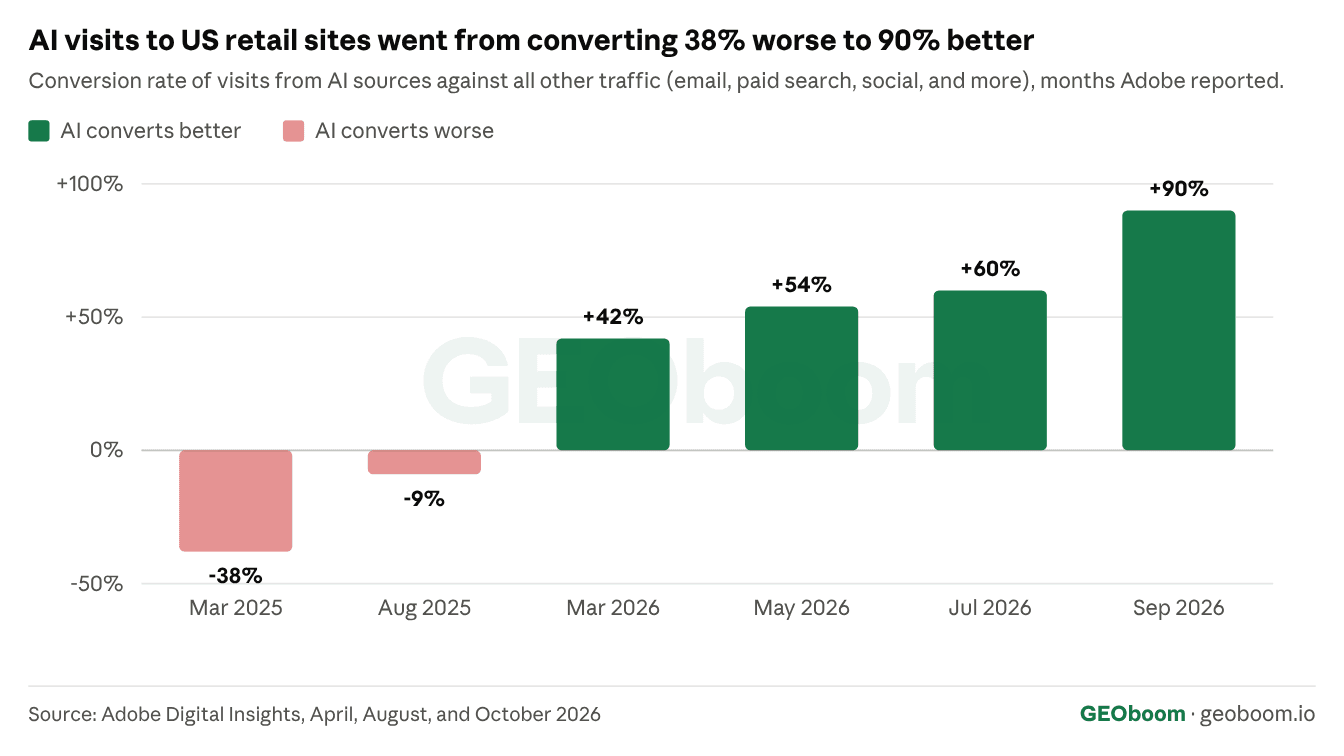
- Revenue per visit followed. AI visits to US retail sites brought 37% more revenue per visit than other traffic in March 2026, 53% more in July, and 83% more in September. In July 2025, other visits had been worth 128% more than AI visits (Adobe).
- The peer-reviewed study saw the same direction. In Kaiser and Schulze's data, ChatGPT's conversion rate and revenue per session rose over the study period, while order values fell.
Two cautions. A higher rate on a small channel still adds up to few sales, as Haynes' numbers in the Google section show. And people who click through from an AI answer have often made up their minds already, so a higher rate doesn't prove the AI made the sale.
Where does AI traffic land, and where else does it go?
Mostly on homepages, and often not on your site at all. About 60% of AI-referred visits land on a homepage, compared with 17% of organic search visits, SE Ranking found.
- Internal search pages. Across 166 sites, about 25% of AI-referred traffic landed on a site's own search results. For ChatGPT it was 28.8% (Previsible). In e-commerce, product pages took 43% of AI visits. In health, About pages took 42.1%.
- Few links to click. In May 2026, 6.8% of US ChatGPT answers on desktop included a link to a source (Similarweb). ChatGPT ran a web search on 34.5% of prompts in February 2026, down from 46% in late 2024 (Semrush).
- Google gets a big share of ChatGPT's clicks. In US clickstream data, 21.6% of ChatGPT's outbound clicks went to Google, up from about 14% in late 2024. The top 10 domains took just over 30% (Semrush). Semrush suggests people go to Google to check what ChatGPT told them and to find brands they just discovered.
- Google is the next stop on desktop too. In the second quarter of 2026, Google was the site US desktop users visited most often right after an AI tool, ahead of YouTube, Microsoft, and ChatGPT itself. Wikipedia dropped out of the top 15 in the US and in Europe (Datos and SparkToro).
That suggests a lot of what AI does for a brand happens before any visit. It names the brand, and the person may then search for it on Google or type the address. Neither shows up as AI traffic in analytics.
Which industries get the most AI referral traffic?
Education, software, and travel sites get the most AI visits for the Google traffic they have. Marketplaces and online stores get the most in raw numbers. SEOcrawl AI measured the median for each industry:
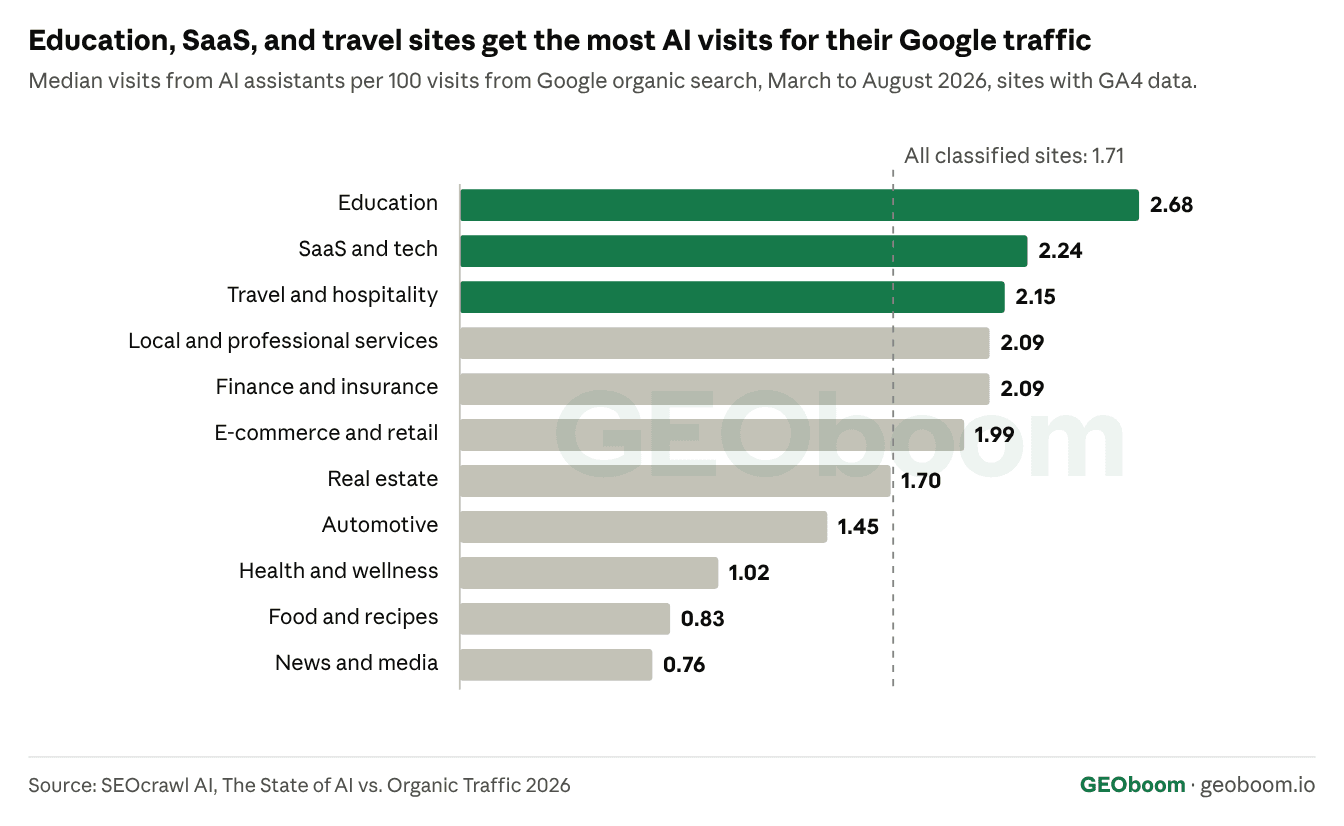
- A high share doesn't mean growth. AI traffic to SaaS and tech sites fell 18% from a year earlier, education fell 8%, and news fell 16%. Travel grew 120%, and e-commerce 54% (SEOcrawl AI, medians).
- Enterprise data points the same way on tech. Information technology had the highest AI share, 2.80%, in Conductor's 2025 benchmark of US enterprise sites. Communication services had the lowest, 0.25%.
- Volume goes to marketplaces. Marketplaces got the most AI referral visits worldwide, 46.8 million a month on average from June 2025 to May 2026, with news and travel close behind. Beauty grew fastest, up 312.5% (Similarweb).
- Small sites get relatively more. Sites with under 100 Google clicks a month got 3.98 AI visits per 100 Google visits. Sites with over 100,000 got 1.02 (SEOcrawl AI).
- Retail keeps growing. AI traffic to US retail sites grew 71% year over year in September 2026, and AI's share of visits to travel sites grew 119% year over year in July (Adobe).
Why is AI referral traffic hard to measure?
Analytics only sees a visit from AI when it arrives with a referrer or a tag, and many don't. Every number in this article is a floor.
- GA4's AI Assistant channel. Since May 13, 2026, Google Analytics puts visits from chatbots like ChatGPT, Gemini, and Claude in a new AI Assistant channel in its default reports (Google). It works from the referrer, so a visit without one still lands in Direct.
- Google's own AI features count as organic. A click from an AI Overview or AI Mode comes from google.com, so GA4 files it under Organic Search. None of the studies here include those clicks. Search Console's report on Google's AI features counts links shown, with no clicks (Search Engine Journal).
- ChatGPT visits depend on a tag. ChatGPT adds utm_source=chatgpt.com to its links. On Graphite's sites, 95% of mobile ChatGPT visits relied on that tag alone (Search Engine Journal).
- The October 2026 gap. After GPT-6 rolled out on October 7 and 8, links in ChatGPT answers arrived without the tag or a referrer. ChatGPT sessions in GA4 fell 22% to 57% on Graphite's sites. On about 500 pages tracked by Adobe's Cedric Huesler, ChatGPT visits fell by about 31,000 a day while Direct rose by about 26,000. Huesler says OpenAI confirmed a bug on October 14 and a fix began on October 15.
If you report on AI traffic, mark October 8 to 15, 2026 in your data. Compare ChatGPT and Direct for the same pages and for your homepage over that week.
What should you do about AI referral traffic?
Get your brand named in AI answers and on the pages those answers cite. The clicks are small, and the answers reach far more people than the clicks do.
- Track the AI Assistant channel by landing page. Expect most visits on your homepage. Compare their conversion rate with organic search on your own site before you plan around anyone's averages.
- Track visibility apart from clicks. Search Console's report on Google's AI features shows how often links to your site appear in AI Overviews and AI Mode. For ChatGPT, Gemini, and Claude, check by hand or with a prompt tracker whether your brand gets named for the questions your buyers ask. Pages that already name you without linking are free to pull up too.
- Find the pages AI already cites and get on them. In AirOps' study of 21,311 brand mentions (October 2025), 85% came from sites the brand doesn't own, and nearly 90% of those were listicles, comparisons, or reviews. Since May 2026, a brand named in a ChatGPT answer can link straight to its site, so a mention can now bring the visit too. To see which pages come back for a question your buyers ask, start with one keyword, free.
- Keep your Google rankings. Google sends 80 to 190 times as many visits, and 21.6% of ChatGPT's own clicks go to Google. More on how links and mentions work in AI search: brand mentions vs backlinks in AI search and zero-click search statistics.
That's what GEOboom does. It's link building and mention outreach software that finds the pages Google ranks and AI answers cite, writes to the people who run them, and brings back placement offers. Two GEOboom cases show what being named looks like:
- Named in an AI Overview. One email and 18 days to a live placement, a mention exchange with $0 paid to the site. After it, GrowPad was #2 of 5 in Google's AI Overview for "best seo agency for startups" and #1 in Perplexity's shortlist for Spain.
- Seen in Search Console. Links to growpad.pro were shown 92.7K times in Google's AI features in three months, with a jump from late October. The five GrowPad lists that grew most went from 2,054 impressions in one week to 16,604 in the next. growpad.pro got 1,281 clicks from Google search over the same three months (case D). GrowPad also rewrote those lists in October.
To compare tools that do this work, see our 8 best AI link building tools.
AI referral traffic: FAQ
How much traffic does ChatGPT send to websites?
About 0.2% of all visits. ChatGPT brought 0.21% of traffic to 76,000 sites in Ahrefs' data, and 0.62 sessions for every 100 from Google organic across Marie Haynes' 100 sites. It accounts for 62.6% to 96.3% of all AI referrals, depending on the study.
Does AI traffic convert better than Google traffic?
Often, in 2026 data. ChatGPT visitors converted at 13.8% against 3.02% from Google organic on 55 sites (Marie Haynes), and AI visits to US retail sites converted 90% better than other traffic in September 2026 (Adobe). A peer-reviewed study of 973 online stores in 2024 to 2025 found the opposite, so check your own numbers.
Which AI assistant sends the most traffic?
ChatGPT, with 62.6% to 96.3% of AI referrals across six studies. Gemini is usually second. On B2B sites, Claude can be second: 18.5% in Goodie's panel.
How do I see AI referral traffic in GA4?
Open the Traffic acquisition report and look for the AI Assistant row in the session default channel group. Google added it on May 13, 2026. Visits that arrive without a referrer still show as Direct, and clicks from AI Overviews show as Organic Search.
Why did my ChatGPT traffic drop in October 2026?
Most likely it's a tracking problem. From about October 8 to 15, ChatGPT links arrived without their tag or a referrer, so GA4 counted those visits as Direct. Adobe's Cedric Huesler says OpenAI confirmed a bug and a fix started on October 15. Compare ChatGPT and Direct for the same pages over that week.
Methodology
This article brings together 16 published studies on the traffic AI assistants send to websites. We opened each study, checked every number against it on November 13, 2026, and noted who ran it.
| Study | Who and when | What it counts | Sample | Who runs it |
|---|---|---|---|---|
| AI traffic grew 16x from 2024 to 2026 | Yulia Deda, SE Ranking, June 18, 2026 | Share of website traffic from AI assistants in Google Analytics, January 2025 to April 2026 | 101,574 sites in 250 countries | Sells SEO software |
| Referral traffic from ChatGPT hit an all-time high in May 2026 | Yulia Deda, SE Ranking, July 9, 2026 | ChatGPT's share of referral traffic by month, January 2025 to May 2026 | The same 101,574 sites | Sells SEO software |
| ChatGPT has 12% of Google's search volume but Google sends 190x more traffic | Patrick Stox, Ahrefs, February 11, 2026 (updated June 5, 2026) | Share of traffic from Google and ChatGPT in Ahrefs Web Analytics, period not given | 76,000 sites | Sells SEO software |
| The State of AI vs. Organic Traffic 2026 | David Kaufmann, SEOcrawl AI, October 2026 | GA4 sessions from AI assistants, March 2025 to August 2026, against Search Console clicks; the same sites every month; medians | 3,949 sites with GA4 (3,099 with full history), 16,661 in Search Console | Sells SEO software |
| The 2026 AEO / GEO Benchmarks Report | Conor Baker and Wesam Rafidi, Conductor, November 2025 (updated July 6, 2026) | AI referral share of sessions, US, May to September 2025 | 1,215 enterprise customer domains, 3.3 billion sessions | Sells AEO and SEO software |
| GEO is a distraction | Marie Haynes, October 21, 2026 | GA4 sessions and conversions from ChatGPT and other AI tools against Google organic, 12 months, exact dates not given | 100 sites, over 145 million sessions; 55 track conversions | SEO consultant |
| 2026 State of AI Discovery Report | David Bell, Previsible, July 6, 2026 | GA4 sessions from standalone AI assistants, November 2024 to May 2026; AI Overviews left out | 166 GA4 properties, 6.77 million sessions | GEO and SEO agency |
| BrightEdge AI Market Pulse and May 20, 2026 release | BrightEdge, data to September 2026 (history revised July 2026) | Share of AI referrals by assistant | Not given | Sells enterprise SEO software |
| 2026 AI Search Traffic Report | Mostafa ElBermawy, Goodie, May 21, 2026 | Share of AI referrals per brand in GA4, averaged across brands, March to April 2026 | Mostly B2B brands, number not given | Sells AEO software |
| ChatGPT referral traffic near triples overnight | Adelle Kehoe, Similarweb, May 25, 2026 | ChatGPT referrals before and after May 7, 2026, desktop panel, April 30 to May 20 | Not given | Sells web traffic data |
| AI referral traffic by industry | Maayan Zohar Basteker, Similarweb, September 3, 2026 | AI referral visits worldwide, desktop and mobile web, June 2025 to May 2026; share of US ChatGPT answers with a source link | Not given | Sells web traffic data |
| ChatGPT traffic analysis: insights from 17 months of clickstream data | Nikola Manojlović and Christine Skopec, Semrush, April 7, 2026 | Where US ChatGPT users went next, mobile and desktop, October 2024 to February 2026 | Over 1 billion clickstream lines from a 200-million-user panel | Sells SEO software; owns Datos |
| State of Search Q2 2026 | Datos and SparkToro, July 2026 | The next site visited after an AI tool, desktop, US and EU/UK, Q2 2025 against Q2 2026 | "Tens of millions" of desktop users | Datos sells clickstream data and is a Semrush company |
| Adobe Digital Insights: April 16, August 19, and October 29, 2026 | Vivek Pandya, Adobe | Clicks from AI sources to US retail sites against all other traffic, March 2025 to September 2026 | Over 1 trillion visits | Sells analytics and marketing software |
| ChatGPT referrals to e-commerce websites | Maximilian Kaiser and Christian Schulze, Marketing Science, April 21, 2026 | Traffic, conversion, and revenue by channel, last click, July 2024 to August 2025 | 973 online stores, about $20 billion in revenue, over 50,000 ChatGPT transactions | University of Hamburg and Frankfurt School; peer-reviewed journal |
| AI traffic converts at 3x the rate of other channels | Ihab Rizk, Microsoft Clarity, November 6, 2025 | AI traffic growth over eight months and conversion over one month | Over 1,200 publisher and news sites | Microsoft, which also runs Copilot |
How we compared. A share of all traffic, a ratio to Google organic, and a share of AI referrals are three different measures, so they sit side by side. We don't average them. "AI referral" here means a visit from a link in a standalone assistant like ChatGPT, Gemini, Claude, Perplexity, or Copilot. Clicks from Google's AI Overviews and AI Mode aren't in any of these numbers.
Notes on the numbers. SE Ranking's 0.32% for all AI in January to April 2026 and its 0.32% for ChatGPT alone in May 2026 are different measures that happen to match. BrightEdge revised its history in July 2026 after changes in how analytics tools count ChatGPT referrals. In May it had put ChatGPT at 79.0% of AI referrals for April 2026, so its figures from before and after the revision don't line up. Goodie averages each brand's shares, so its five shares add up to more than 100%. Haynes doesn't give exact dates, industries, or how conversions were defined, and Ahrefs doesn't give the period. Adobe's "non-AI traffic" includes email, paid search, and social. ChatGPT data after October 8, 2026 is undercounted for about a week.
Not included: Semrush's "AI visitor is worth 4.4x an organic visitor" (July 2025; no sample or method given, and the same piece forecasts AI search passing traditional search by 2028); Ahrefs' "0.5% of traffic, 12.1% of sign-ups" (2025, one site, Ahrefs itself); First Page Sage's "dark AI traffic" and "6.2% of sessions" (an agency's client sites, partly projected from a panel, and far above every other study); NP Digital's "6.2% of traffic, 11.4% of sales" (a survey of companies, not a measurement); "AI referrals convert at 11.4% against 5.3%" credited to Similarweb (we couldn't find it on a Similarweb page); Visibility Labs' study of 94 online stores (we could open only news coverage, not the report); Seer Interactive's ChatGPT case (one client, 2025); and bot and crawler traffic (HUMAN, Fastly, Cloudflare), which counts machines, not people clicking.
Disclosure: GEOboom is our product. It's link building and mention outreach software. Every number here comes from other people's studies, except the two GEOboom cases with GrowPad. The author, Oleksii Andrusenko, is Head of Marketing at GEOboom and the CEO of GrowPad, the client in both cases.
We plan to recheck these studies every quarter. Next check: February 2027.
Use this data. The charts and figures on this page are free to use with a link to this page. Every number is also in one CSV file, ai-referral-traffic-statistics-2026.csv, under a CC BY 4.0 license, with the study, its date, its method, its sample, and a link to the source on each row.
Related
- Zero-click search statistics 2026: 19 studies side by side
- Brand mentions vs backlinks in AI search: 15 studies (2026)
- Link building statistics 2026: 117 backlink stats, 23 studies
- 8 best AI link building tools in 2026, compared
- Case study: named in Google's AI Overview and Perplexity
- Case study: 64 exchange offers, $0 paid to publishers
This study is published by GEOboom, outreach software for getting your brand mentioned on the pages AI answers cite.