
68.01% of Google searches in the US ended without a click in January to April 2026, SparkToro found in Similarweb data. Ten years ago it was about 45%, measured on a different panel.
- Europe. In SparkToro's data for five more countries, the share runs from 62.1% in Germany to 69.5% in the UK.
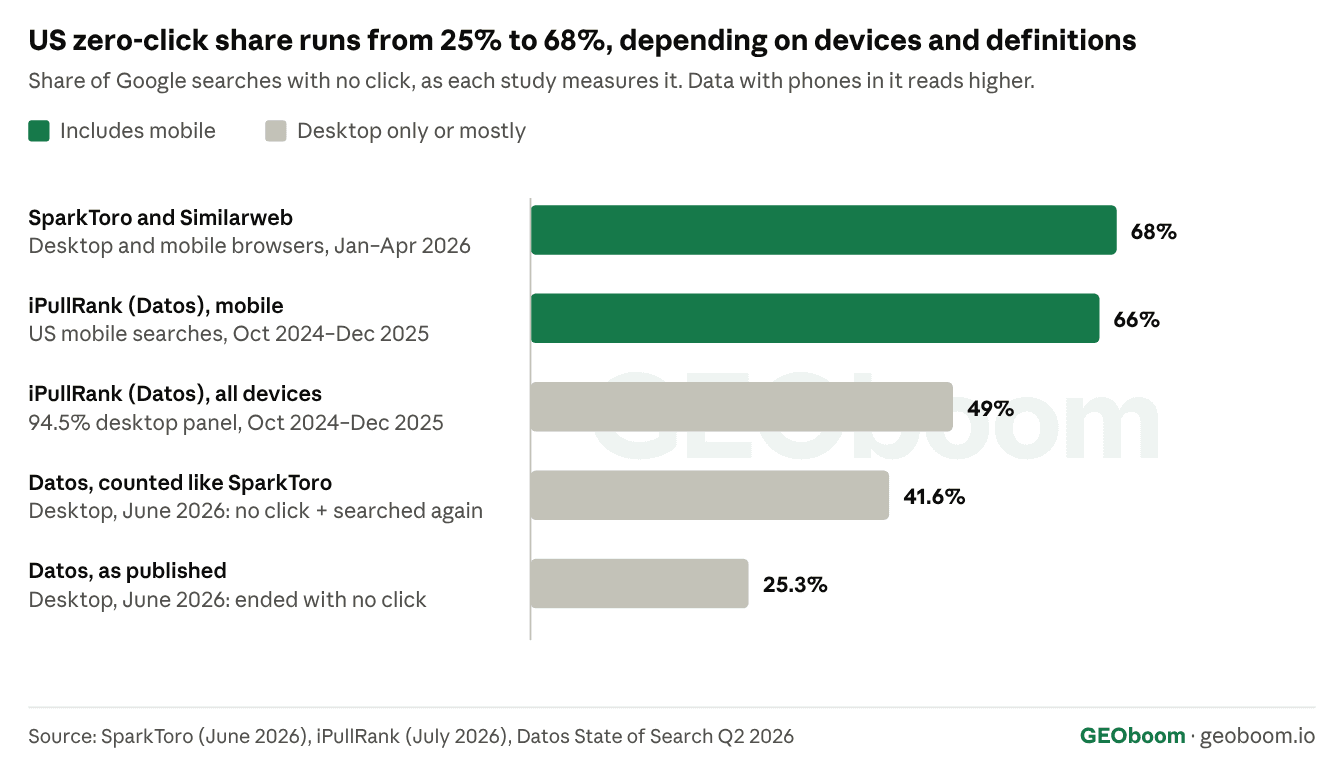
- Other methods, other numbers. iPullRank counted 46.96% across 10.2 billion searches from October 2024 to December 2025, most of them on desktop. Desktop-only data from Datos gives 25.3% for the US in June 2026, because it counts a repeat search separately.
- AI Overviews. In a field experiment with 1,065 people, searches with no click rose from 54% to 73% when an AI Overview showed. In Pew Research Center's data, people clicked a link inside the AI summary on 1% of visits.
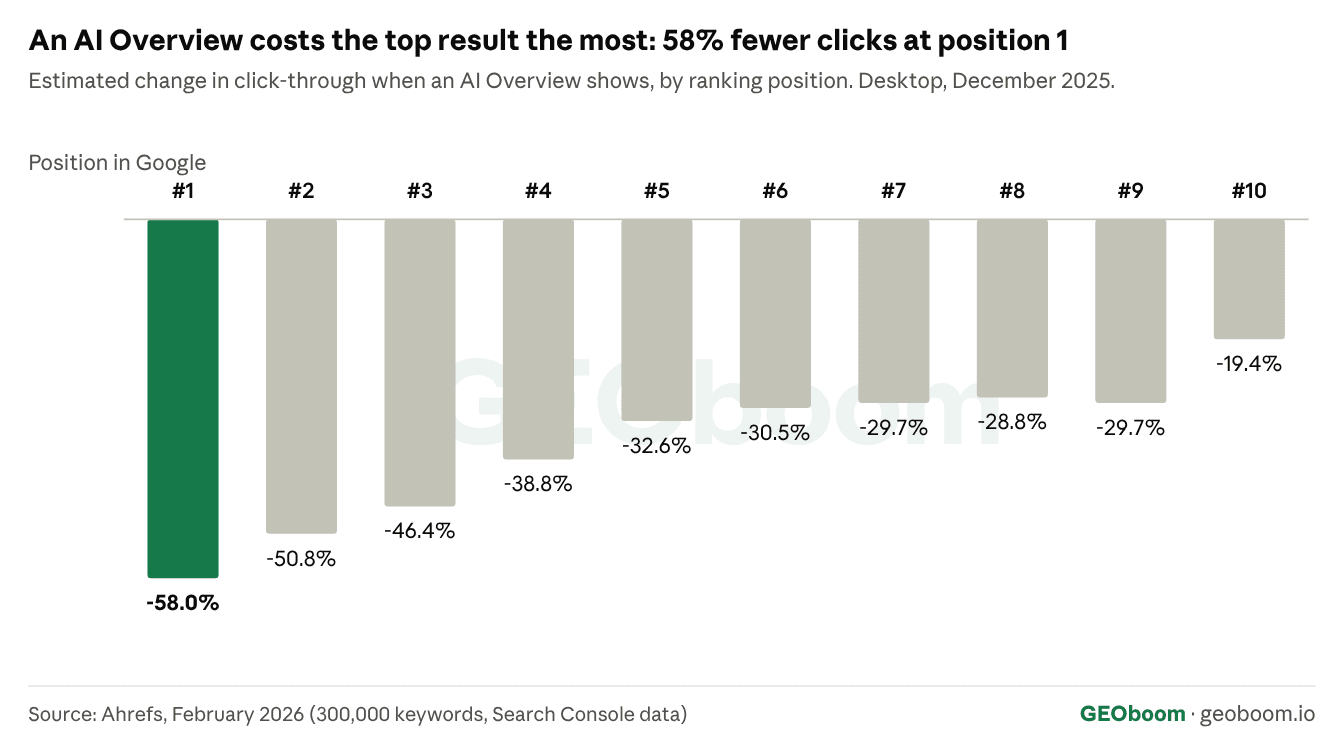
- The top result. With an AI Overview on the page, the first result gets 58% fewer clicks than it otherwise would, Ahrefs estimates.
- AI Mode. Only 0.34% of US searches went to AI Mode in early 2026. When researchers moved people's searches into AI Mode, clicks to websites fell by 18.8 percentage points.
- Where visits go. Of every 1,000 US Google searches, 231 send a visitor to a website outside Google. AI assistants send 0.32% of all website traffic, SE Ranking found across 101,574 sites.
Fewer searches end in a click, so the answer often stays on Google or in the AI tool. That makes it worth being named in the answer and on the pages it cites: in Seer Interactive's data, cited brands got more clicks than uncited ones on the same searches.
Each study counts something different: a panel of browsers, Search Console data, or a field experiment. So we show them side by side and don't average them. Studies checked November 12, 2026. GEOboom is our product. How we compiled this is in Methodology.
How many Google searches end without a click in 2026?
About two in three. SparkToro's 2026 study puts the US share at 68.01% for January to April 2026. The data comes from Similarweb's panel of desktop and mobile browsers, weighted two-thirds mobile.
Here's what happened after 100 US searches:
- 32 ended with a click on something: a website, an ad, or a Google property like YouTube or Maps.
- 29 led to another Google search.
- 39 ended the search session.
The last two groups make up the zero-click share. The study doesn't include the Google app on phones, where Google answers even more on the page. So SparkToro thinks the real share is higher.
From 2024 to 2026, searches with at least one click fell 9.51 points, a 22.9% drop. Searches followed by another search rose 7.2 points.
| Year | Zero-click share | Panel | Scope |
|---|---|---|---|
| 2026 (Jan–Apr) | 68.01% | Similarweb | US, desktop and mobile browsers |
| 2024 (Jan–May) | 58.5% | Datos | US, desktop and mobile (SparkToro, 2024) |
| 2020 | 64.82% | Similarweb | Worldwide, desktop and mobile (SparkToro, 2021) |
| 2019 | 49% | Jumpshot | As cited in SparkToro's 2026 post |
| About 2016 | About 45% | Jumpshot | As cited in SparkToro's 2026 post |
The rows come from different panels, so they show the direction, not the exact pace. Rand Fishkin calls the comparison "apples and oranges" himself. Note that SparkToro's 2026 post gives 60.45% for 2024, while its 2024 study reported 58.5%. The post doesn't explain the difference.
Why do studies show 25%, 47%, or 68%?
Two things drive the gap: devices and what counts as "no click." People click less on phones, so data that leans on desktop gives a lower number. Who is in the panel and which countries it covers matter too.
| Study | Method | Devices | Region and period | Zero-click share |
|---|---|---|---|---|
| SparkToro and Similarweb, June 2026 | Clickstream panel | Desktop and mobile browsers, weighted two-thirds mobile | US, Jan–Apr 2026 | 68.01% |
| iPullRank, July 2026 | Clickstream panel (Datos), 10.2 billion searches | 94.5% desktop | Many countries, Oct 2024–Dec 2025 | 46.96% overall, 49% in the US, 66% on US mobile |
| Datos State of Search Q2 2026, July 2026 | Clickstream panel | Desktop only | US and EU/UK, Apr 2025–Jun 2026 | US, June 2026: 25.3% ended with no click, 41.6% with repeat searches counted. EU/UK: 22.9% |
| Agarwal and Sen, June 2026 | Field experiment, 1,065 people | Desktop Chrome | US, Jan–Feb 2026 | 54% without an AI Overview, 73% with one, on searches that trigger it |
| Bain and Dynata, February 2025 | Survey of 1,117 consumers | Any | US, December 2024 | About 60% of searches, by people's own estimate |
A few things to keep in mind when you quote these numbers:
- Phones click less. In iPullRank's data, US mobile searches end without a click 17 points more often than desktop ones. SparkToro weights its panel two-thirds mobile.
- The Google app is left out. SparkToro's panel sees mobile browsers, not the Google app, where Google answers even more on the page.
- "No click" means different things. Datos counts a search followed by another search apart from a search that ended with no click. In June 2026, 25.3% of US desktop searches ended with no click and 16.3% led to another search. SparkToro counts both as zero-click, which would make it 41.6% (our sum).
- Search Console data answers another question. Ahrefs and Seer measure how often people click a site's result. A site's click-through rate isn't the share of searches with no click.
- Check the averages. iPullRank's headline is 46.96%, but its highest month was 45.6%. An average can't sit above every month, so one of the figures is likely off. We quote it as "about 47%."
How many searches end without a click in Europe?
About the same as in the US, a bit lower on the continent. In SparkToro's six-country data for January to April 2026, the UK has the highest zero-click share at 69.5% and Germany the lowest at 62.1%. France, Italy, and Canada sit in between.
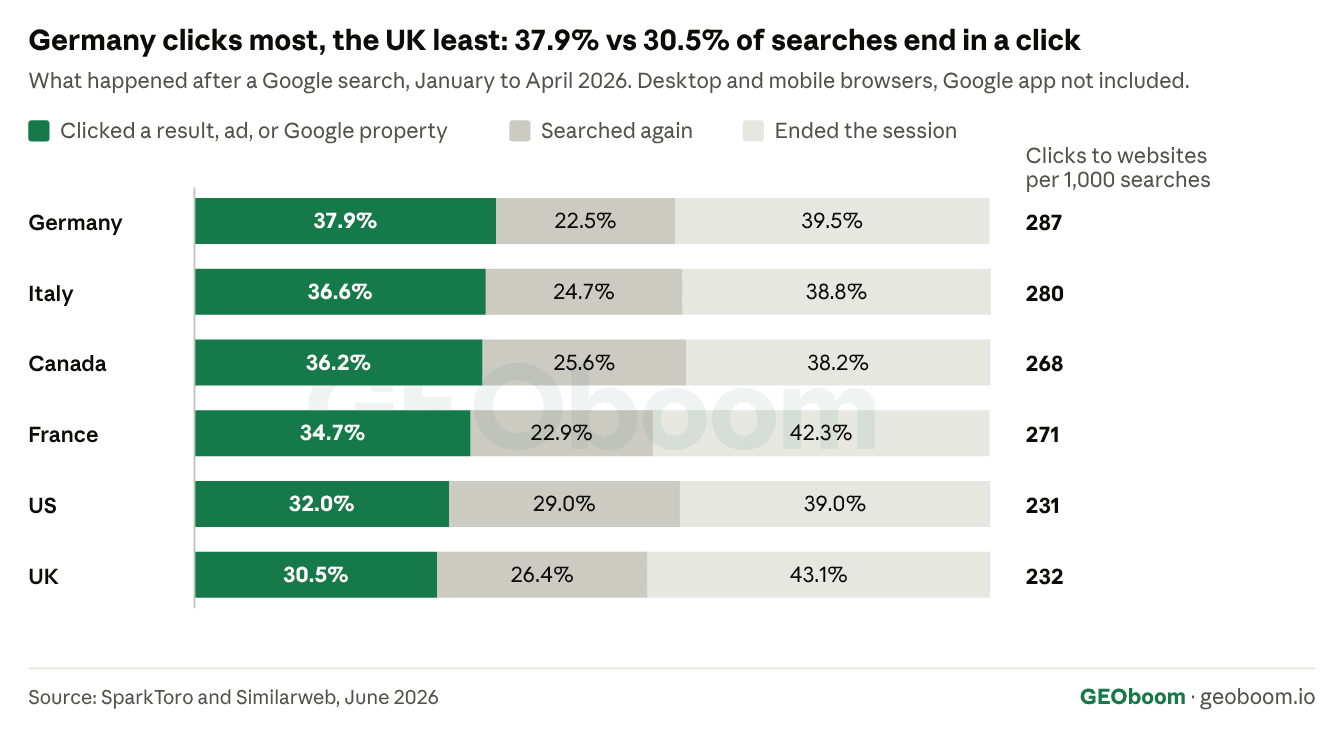
- Germany clicks most. 37.9% of German searches end with a click, against 30.5% in the UK. That's 287 clicks to websites per 1,000 searches in Germany and 232 in the UK.
- No country reaches 300. None of the six sends 300 or more clicks to websites per 1,000 searches.
- Why the gap is unclear. Rand Fishkin suggests EU rules against Google favoring its own services may keep people clicking. He also says it could be culture, language, or how Google looks in each country. Canada clicks more like Europe than like the US.
- 2024 looked similar. In SparkToro's 2024 study on Datos data, 59.7% of EU searches and 58.5% of US searches ended without a click. The EU sent 374 clicks to websites per 1,000 searches, the US 360.
Desktop data points the same way. In Datos' panel, 22.9% of EU and UK Google searches ended with no click in June 2026, and another 14.6% led to a repeat search. Clicks to Google's own properties reached a record 20.4%, up from 11.7% in April 2025.
France shows what happens when AI Overviews arrive. Google launched them there on July 22, 2026. Ahrefs tracked 963 French domains in Search Console for 28 days before and 9 days after. Click-through fell 3.4% across all of them and 23.1% for sites where more than 20% of queries show an AI Overview. Ahrefs plans to rerun it over a longer period.
Is zero-click higher on mobile than on desktop?
Yes, in English-speaking countries by a lot. In iPullRank's Datos data, 65% of UK mobile searches ended without a click, against 46% on desktop. In the US, the mobile share was 66%, 17 points above desktop.
- The gap depends on the country. It's 15 to 19 points in the UK, US, Canada, and Australia. In Indonesia, the Philippines, Vietnam, and Japan it's about 6 points.
- Five markets pass 60% on mobile. The US (66%), the UK (65%), Australia (64%), Canada (62%), and Mexico (61%).
- Mobile clicks go to ads more often in some markets. In the UK, 9.4% of mobile clicks were on ads, against 6.3% on desktop. In France, Italy, Spain, and Brazil, mobile clicks lean organic.
- Desktop-only data reads lower. In Datos' desktop panel, 25.3% of US searches and 22.9% of EU and UK searches ended with no click in June 2026, not counting repeat searches.
You'll often see "77% of mobile searches are zero-click." That figure is worldwide data for 2020, from SparkToro's 2021 study. Treat it as a 2020 number. SparkToro's 2026 study weights mobile at two-thirds of searches but doesn't publish separate device rates.
What do AI Overviews and AI Mode change?
They cut clicks to websites. Two field experiments now show the cause directly.
AI Overviews
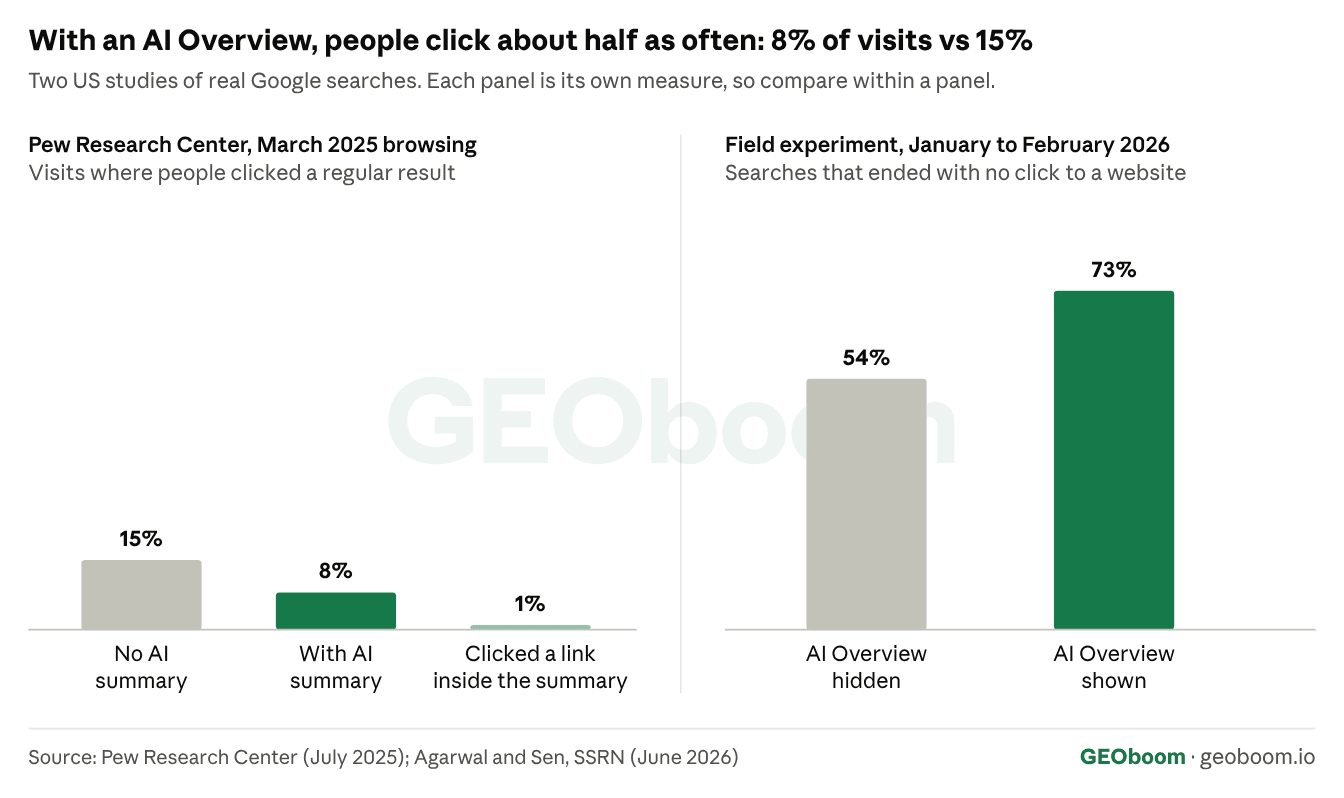
- Field experiment. Saharsh Agarwal and Ananya Sen (Indian School of Business, Carnegie Mellon) used a Chrome extension to hide AI Overviews for some of 1,065 US desktop users, January to February 2026. AI Overviews showed on about 41% of 68,089 searches. When one showed, outbound organic clicks fell 39.8% and searches with no click rose from 54% to 73%. Ad clicks didn't change, and people rated search the same with or without AI Overviews. It's a working paper, not yet peer-reviewed.
- Observed browsing. Pew Research Center followed 900 US adults through 68,879 Google searches in March 2025. With an AI summary on the page, they clicked a regular result on 8% of visits, against 15% without one. They clicked a link inside the summary on 1% of visits, and ended their browsing session more often (26% against 16%).
- Search Console data. Ahrefs compared 300,000 keywords in December 2023 and December 2025. With an AI Overview, the first result gets 58% fewer clicks than expected. In April 2025 the same estimate was 34.5%. The effect shrinks lower down the page.
- Being cited helps, but doesn't undo it. In Seer Interactive's data on 53 brands, organic click-through on informational searches with an AI Overview averaged 2.07% in 2025 for brands cited in it and 0.94% for brands that weren't (about 1.61% without one large account). Without an AI Overview it was 3.35%. Seer adds that stronger brands are more likely to be cited, so the gap isn't proof of cause.
AI Overviews show up mostly on questions. Seer saw them on 36% of informational searches, 8% of commercial ones, and 5% of transactional ones. Pew saw them on 53% of searches with 10 or more words.
AI Mode
- Few people use it yet. Only 0.34% of US searches went to AI Mode in January to April 2026, SparkToro found. On desktop, AI Mode made up 0.12% to 0.13% of US activity in April to June 2026 and 0.29% in Europe in June, Datos found.
- It sends far fewer clicks. In a second field experiment (University of Pennsylvania and Northeastern University, 1,100 US participants, March 2026), moving people's searches into AI Mode cut click-through to websites by 18.8 percentage points. AI Mode showed no ads at the time.
- Most AI Mode sessions end on Google. In Semrush's clickstream data, 92% to 94% of AI Mode sessions didn't lead to another site. That's US desktop data from May to July 2025, the first two months after launch.
What Google and one test site say
Google's head of Search, Liz Reid, wrote in August 2025 that total organic clicks from Search have been "relatively stable year-over-year." The post gives no numbers.
One site measured its own AI clicks. Cyrus Shepard turned Zyppy's site off in Google's AI features for 28 days in September 2026 and compared. He estimates a click-through rate of about 0.9% on AI Overview and AI Mode impressions, against 0.4% for the site in Google Search overall. AI features brought about 21% of its clicks. He calls it a single test on a single site.
Where do the clicks go: Google, ads, or the open web?
Most clicks still go to websites, through organic results and ads. What shrinks is organic. In SparkToro's 2026 data, 72.3% of US clicks went to organic or paid results and 8.4% to Alphabet's own sites, like YouTube and Maps. That's 231 clicks to websites per 1,000 searches.
- Organic is what falls. In iPullRank's data, the share of searches ending in an organic click fell about 2.8 points from late 2024 to late 2025. Ad clicks didn't change. The field experiment found the same: AI Overviews cut organic clicks and left ad clicks flat.
- Ads take a bigger slice on branded searches. In iPullRank's data, 4.4% of clicks on branded searches went to ads, against 3.3% on other searches.
- Most clicks are discovery. Only about 14% of Google clicks went to a site the searcher named in the query. The other 86% went to sites people didn't ask for by name.
- Google answers some sites' searches itself. For searches that usually lead to Wikipedia, Google kept 30.5% on its own page. For IMDb it was 33.4%. For Reddit it was 14.2%. iPullRank's reading: Google can't replace a thread of people arguing.
- Google's own properties. SparkToro's 2024 study put almost 30% of clicks on Google-owned platforms. The 2026 post gives 8.4% but uses a different panel and doesn't compare the two. Don't read it as a drop.
On desktop, Google keeps a growing share. In Datos' panel, clicks to Google's own properties rose from 14.8% of US desktop searches in March 2026 to 17.1% in June. Organic clicks fell from 44.9% to 40.0%, the lowest since April 2025. In the EU and UK, Google's own properties got a record 20.4% in June. Rand Fishkin calls that low for clicks to other sites "the number I like least."
SparkToro also says paid clicks grew a lot from 2024 to 2026, without a number. Its 2024 panel had more ad blockers than average, so 2024 ad clicks were likely undercounted.
How much traffic do AI assistants send?
Very little so far, but it's growing fast. AI assistants sent 0.32% of all website traffic in 2026, SE Ranking found in Google Analytics data from 101,574 sites in 250 countries. That's about 1 in 312 visits, up from 0.24% in 2025 and 0.02% in 2024. On desktop, AI tools made up 1.83% of US activity in the second quarter of 2026, against 10.52% for traditional search, in Datos' data.
- Google still sends far more. Organic search brought 42.75% of traffic to the same sites, about 134 times more than AI.
- ChatGPT sends most of it. Its share of AI referrals was 74.78% in 2026, then Gemini (11.56%), Perplexity (7.23%), Copilot (3.51%), and Claude (2.62%).
- AI visitors stay longer. An average session from AI lasted 9 minutes 19 seconds, against 5 minutes 33 seconds from organic search. The medians were 2 minutes 24 seconds and 1 minute 53 seconds.
For now, AI reaches most brands through what its answers say more than through the visits it sends.
What to do when fewer searches click
Get your brand named in the answer and on the pages the answer cites. When two in three searches end on Google, that's where people see you.
- Count visibility, not only clicks. Search Console now has a report on Google's AI features. An impression there is a link to your site shown in an AI Overview or in AI Mode. It counts links to your site, so a brand mention without a link doesn't show there, and the report has no clicks (Search Engine Journal).
- Find the pages AI answers already cite. They're mostly other people's pages. In AirOps' study of 21,311 brand mentions (October 2025), 85% came from sites the brand doesn't own, and nearly 90% of those were listicles, comparisons, or reviews. "Best X" lists made up 43.8% of the pages ChatGPT cited in Ahrefs' study.
- Get mentioned on those pages, with or without a link. Across 75,000 brands, mentions on the web tracked AI Overview visibility about three times more closely than backlinks (0.664 against 0.218). More numbers on links and mentions are in our link building statistics and in brand mentions vs backlinks in AI search.
- Keep the pages that still earn clicks. Searches for products, tools, and communities still end in a click far more often than fact lookups. 86% of Google clicks go to sites people didn't name in the query (iPullRank).
That's what GEOboom does. It's link building and mention outreach software that finds the pages Google ranks and AI answers cite, writes to the people who run them, and brings back placement offers. Two GEOboom cases show what being named looks like:
- Named in an AI Overview. One email and 18 days to a live placement, a mention exchange with $0 paid to the site. After it, GrowPad was #2 of 5 in Google's AI Overview for "best seo agency for startups" and #1 in Perplexity's shortlist for Spain.
- Seen in Search Console. Links to growpad.pro were shown 92.7K times in Google's AI features in three months, with a jump from late October. The five GrowPad lists that grew most went from 2,054 impressions in one week to 16,604 in the next. growpad.pro got 1,281 clicks from Google search over the same three months (case D). GrowPad also rewrote those lists in October.
To compare tools that do this work, see our 8 best AI link building tools.
Zero-click search: FAQ
What percentage of Google searches are zero-click?
In the US, 68.01% in January to April 2026, according to SparkToro's analysis of Similarweb data. Across six countries it runs from 62.1% in Germany to 69.5% in the UK. Data that's mostly desktop gives about 47%.
What is a zero-click search?
A search that doesn't end with a click on a website or an ad. The person gets the answer on the results page, searches again, or leaves. In US data for early 2026, 29% of searches led to another search and 39% ended the session.
Do AI Overviews reduce clicks?
Yes. In a field experiment, outbound organic clicks fell 39.8% when an AI Overview showed. Ahrefs estimates the first result gets 58% fewer clicks with an AI Overview on the page.
Does being cited in an AI Overview bring clicks?
Some. In Seer Interactive's data, brands cited in an AI Overview averaged 2.07% organic click-through on informational searches, against 0.94% for brands that weren't cited (about 1.61% without one large account). Both are below the 3.35% on searches without an AI Overview. Pew found people click a link inside the AI summary on 1% of visits.
Is SEO dead in 2026?
No. Organic search still brings 42.75% of website traffic, about 134 times more than AI assistants, in SE Ranking's data. But each search sends fewer clicks, so being named in the answer counts more than before.
How do I measure visibility when clicks go down?
Start with Search Console's report on AI features: it shows how often links to your site appear in AI Overviews and AI Mode. Then track how often AI answers name your brand and which pages they cite.
Methodology
This article brings together published studies on zero-click search, AI Overviews, AI Mode, and AI referral traffic. We opened each study, checked every number against it on November 12, 2026, and noted who ran it.
| Study | Who and when | What it counts | Sample | Who runs it |
|---|---|---|---|---|
| In 2026, less than one third of Google searches still send a click | Rand Fishkin, SparkToro, June 8, 2026, updated June 18, 2026 | What US searchers did after a Google search, Jan–Apr 2026, in Similarweb's desktop and mobile browser panel, weighted two-thirds mobile | Not given | Sells audience research; co-wrote the book Zero Click Marketing. Data from Similarweb, which sells web data |
| Zero-click searches: highest in the UK, lowest in Germany | Rand Fishkin, SparkToro, June 16, 2026 | The same panel for the UK, France, Canada, Italy, and Germany | Not given | Same as above |
| 2024 zero-click search study | Rand Fishkin, SparkToro, July 1, 2024 | US and EU searches in the Datos panel, mobile data Jan–May 2024 | Not given | Data from Datos, a Semrush company |
| In 2020, two thirds of Google searches ended without a click | Rand Fishkin, SparkToro, March 22, 2021 | Worldwide searches in 2020, Similarweb panel | Not given | Same as above |
| What 13 billion Google searches reveal about zero-click behavior | Cate Dombrowski, iPullRank, July 30, 2026 | Searches in the Datos panel, many countries, Oct 2024–Dec 2025, 94.5% desktop | 10.2 billion searches by 9.1 million people | Agency that sells AI search strategy |
| State of Search Q2 2026 | Datos with commentary by Rand Fishkin, July 2026 | Desktop clickstream in the US and EU/UK, Apr 2025–Jun 2026 | Panel of tens of millions of desktop users | Datos is a Semrush company |
| Do people click on links in Google AI summaries? | Athena Chapekis and Anna Lieb, Pew Research Center, July 22, 2025 | Browsing of US adults in March 2025 | 900 adults, 68,879 searches | Nonprofit research center |
| The impact of Google AI Overviews on publisher traffic and user experience | Saharsh Agarwal and Ananya Sen, posted April 3, 2026, last revised July 8, 2026 | Randomized field experiment, US desktop Chrome users, Jan–Feb 2026 | 1,065 people, 68,089 searches | University researchers; working paper, not peer-reviewed |
| AI in search reduces publisher referrals without improving user experience | Stephanie T. Wang, Jeffrey Gleason, Yakov Bart, Christo Wilson, and Danaé Metaxa, August 18, 2026 | Preregistered field experiment, US Chrome users, March 2026 | 1,100 people | University researchers; preprint, not peer-reviewed |
| AI Overviews reduce clicks by 58% | Ryan Law, Ahrefs, February 4, 2026 | Desktop click-through from Search Console, Dec 2023 against Dec 2025 | 300,000 keywords | Sells an SEO toolset |
| AI Overviews cut CTR by 23.1% in France | Juliette Begue, Ahrefs, September 16, 2026 | Search Console data 28 days before and 9 days after the French launch | 963 domains | Sells an SEO toolset |
| AIO impact on Google CTR: 2026 update | Tracy McDonald, Hannah Cooley, and Marketa Williams, Seer Interactive, April 24, 2026 | Organic and paid click-through, Jan 2025–Feb 2026 | 53 brands, 5.47 million queries, 2.43 billion organic impressions | Agency |
| Google AI Mode's early adoption and SEO impact | Luke Harsel, Semrush, July 30, 2025 | US desktop clickstream, May–July 2025 | About 69 million sessions | Sells an SEO toolset |
| We opted out of Google AI search | Cyrus Shepard, Zyppy, November 5, 2026 | One site's Search Console data, 28 days off and 28 days on Google's AI features | One site | SEO consultant |
| AI traffic grew 16x from 2024 to 2026 | Yulia Deda, SE Ranking, June 18, 2026 | Google Analytics traffic sources, Jan 2025–Apr 2026 | 101,574 sites in 250 countries | Sells an SEO toolset |
| Goodbye clicks, hello AI | Bain & Company with Dynata, February 19, 2025 | Survey of US consumers, December 2024 | 1,117 people | Consultancy |
| Third-party sources drive 85% of brand discovery | Oshen Davidson, AirOps, October 17, 2025 | Brand mentions in GPT-5, Claude, and Perplexity answers | 21,311 mentions, 500+ queries | Sells an AI content platform |
| Do self-promotional "best" lists boost ChatGPT visibility? | Glen Allsopp, Ahrefs, December 4, 2025 | Pages ChatGPT cited for 750 prompts | 26,283 source URLs | Sells an SEO toolset |
| AI Overview brand visibility factors | Louise Linehan and Xibeijia Guan, Ahrefs, May 26, 2025, updated April 27, 2026 | What correlates with a brand showing in AI Overviews | 75,000 brands | Sells an SEO toolset |
How we compared. We don't average studies that count different things. A share of searches with no click, a site's click-through rate, and an effect measured in an experiment are three separate measures, so they sit side by side. A percentage point is a difference between two shares. "18.8 points" isn't the same as "18.8%." Charts show each study as published, with its method in the label.
Notes on the numbers. iPullRank's headline (46.96%) is higher than its highest month (45.6%), so we quote it as "about 47%." SparkToro gives two numbers for the US in 2024: 58.5% in the 2024 study and 60.45% in the 2026 post. We show both. Datos' "no click" leaves out repeat searches, so we also show its US figure counted SparkToro's way (our sum). The Agarwal and Sen figures are from the June 17, 2026 paper. The July 8 abstract gives the same 39.8% and 34.5%. The April version gave 38% and 72%. The Wang and others study also tested hiding AI Overviews, but a Google page change broke that test, so we use only its AI Mode result. Seer notes that one account makes up 47% of impressions in the "not cited" group. Without it, that group's click-through is about 1.61%.
Not included: "83% zero-click when an AI Overview shows" (we couldn't find a first source); "77% on mobile, 56% on desktop" quoted as current (the 77% is worldwide 2020 data); Similarweb's "closer to 80% for B2B" (an estimate, not a measurement); Statista's zero-click chart (a paid copy of SparkToro's numbers); and Bain's "15% to 25% less organic traffic" (an estimate without a method).
Disclosure. GEOboom is our product. It's link building and mention outreach software. Every number here comes from other people's studies, except the two GEOboom cases with GrowPad. The author, Oleksii Andrusenko, is Head of Marketing at GEOboom and the CEO of GrowPad, the client in both cases.
We plan to recheck these studies every quarter. Next check: February 2027.
Use this data. The charts and figures on this page are free to use with a link to this page. Every number is also in one CSV file, zero-click-search-statistics-2026.csv, under a CC BY 4.0 license, with the study, its date, its method, its sample, and a link to the source on each row.
Related
- Link building statistics 2026: 117 backlink stats, 23 studies
- Lost backlinks statistics 2026: how long links last and why
- Brand mentions vs backlinks in AI search: what 15 studies show
- 8 best AI link building tools in 2026, compared
- 10 best GEO agencies in 2026, compared
- Case study: named in Google's AI Overview and Perplexity
- Case study: 64 exchange offers, $0 paid to publishers
This study is published by GEOboom, outreach software for getting your brand mentioned on the pages AI answers cite.