
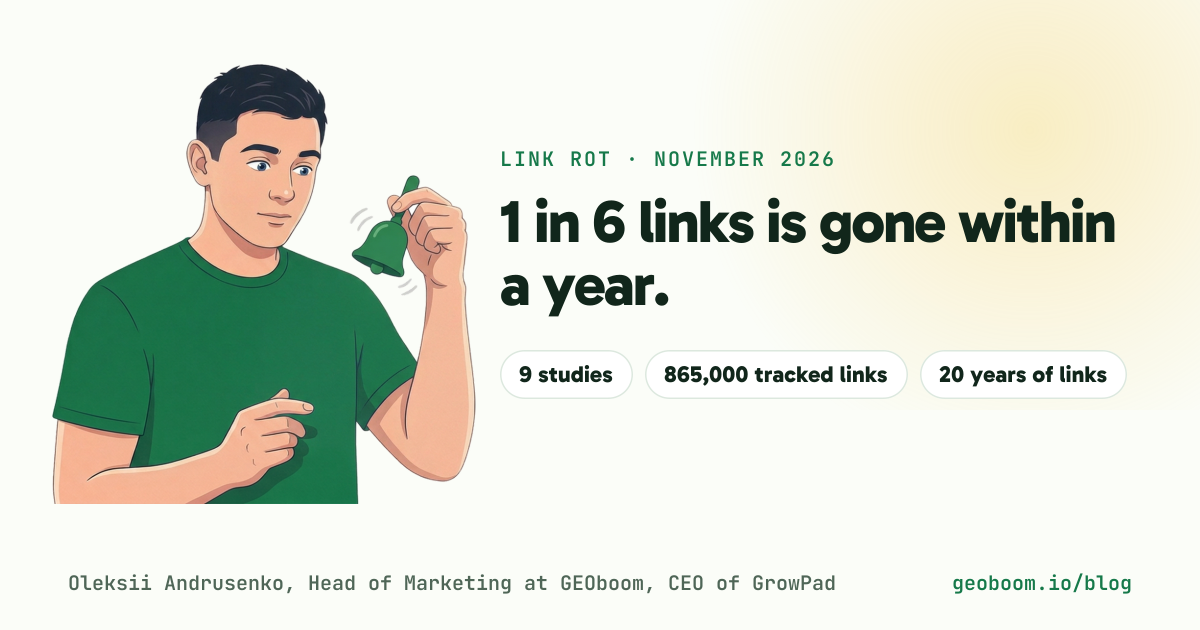
A backlink usually lasts a few years. About 1 in 6 is gone within the first year, and roughly half are gone after three to seven years, depending on whose data you read.
- One year. Linkody's 2022 study found 82% of the links its users track still live after a year, so about 1 in 6 was gone. Its 2026 data on more than 865,000 links puts the figure at about 63%. In Bill Hartzer's 20 years of natural links, 80.9% of linking sites still linked after a year.
- The long run. In Ahrefs' link rot study, 66.5% of the links pointing at 2,062,173 sites since 2013 have rotted, and 74.5% are lost for SEO. In Hartzer's data, 9.5% of linking sites still link after ten years.
- Why. The most common reason is a link removed from a page that's still online: 50.9% of losses in Linkody's 2022 data and 78% in Hartzer's. Only 4 of Hartzer's 645,202 lost links went to a 404.
- Which links last. Links from stronger sites live longer. Hartzer's links from Trust Flow 61+ sites lasted a median of 9.2 years, against 2.4 years for Trust Flow 0. In Linkody's 2026 data, 33% of links on sites under DA 10 are still live, against about 70% on DA 30 to 49.
- Links sold for a set time. In LinkDR's 2026 data, one in four publishers who state their terms sell only time-limited links.
- Your own side. 97.6% of 500 top-ranking business sites have backlinks pointing at their own dead pages. After a platform switch, the median site has 22.7% of its linked URLs dead (PageSpeed Matters).
- Averages mislead. Across 139 Linkody accounts, 14.3% of the links added in 2025 have since been removed. The median account lost 1.8%.
Each study counts something different, from every link a crawler has seen to links people chose to track. So we show them side by side and don't average them. Studies checked November 11, 2026. GEOboom is our product. How we compiled this is in the methodology at the end.
How many backlinks are lost in a year?
Between 1 in 6 and 1 in 3, in the three datasets that track the first year. Links are lost fastest early on.
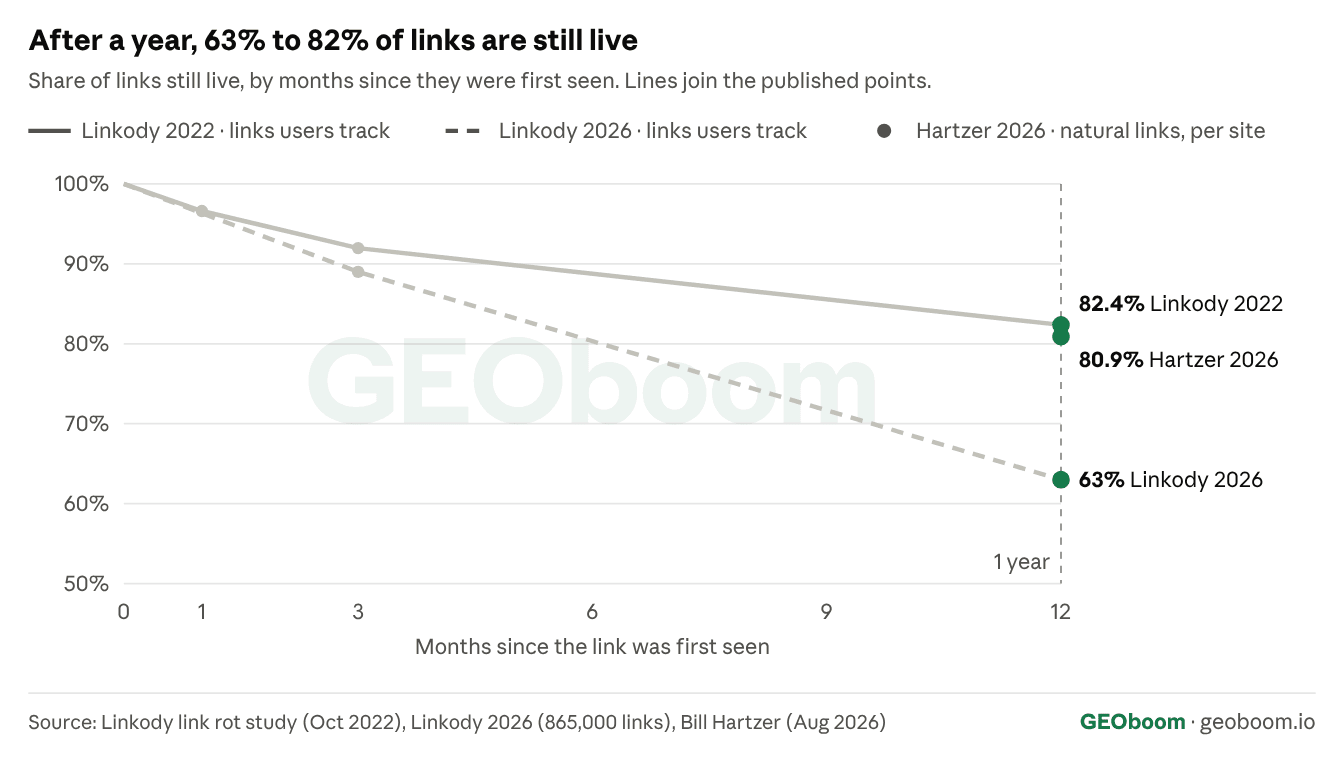
- Linkody, 2022. A survival analysis of millions of links that Linkody users track, each checked every 24 hours. 96.6% were still live after a month, 92% after three months, and 82.4% after a year.
- Linkody, 2026. More than 865,000 tracked links, pulled in June 2026. 89% were live after three months and about 63% after a year. Of the links that died, 52% died in their first year, and the average lifespan to death was about 20 months.
- Bill Hartzer, 2026. 1.3 million links from 22,260 sites to his own blog, from a Majestic export, counted per linking site. 80.9% of those sites still linked after a year.
Linkody doesn't explain why its two studies differ. The 2022 figure comes from a survival curve. The 2026 one groups links by how long they've been tracked, and its clock starts when a user adds a link to the tool, which can be later than the day the link went live.
The average also hides how uneven losses are. Linkody looked at 139 accounts that added at least 30 links in 2025. Pooled, 14.3% of those 234,138 links have since been removed. But the median account lost 1.8%. 73% of accounts lost under 10% of their links, and 10% lost more than 70%.
How many backlinks are lost after 5 or 10 years?
Between 43% and 90%, depending on the study and how far back it looks. Most datasets show more than half gone.
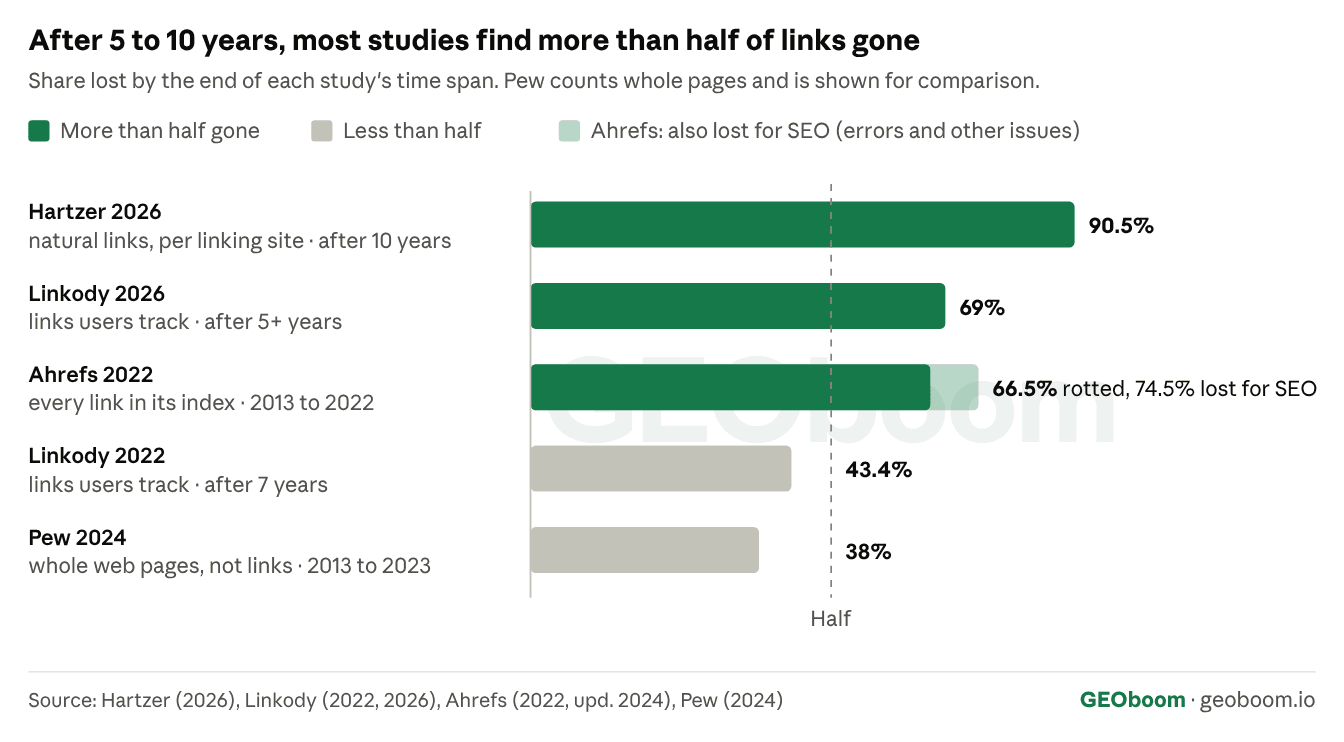
- Ahrefs, 2022 (updated 2024). Since January 2013, 66.5% of the links pointing at the 2,062,173 sites in the sample have rotted. Another 6.45% had temporary errors and 1.55% had other issues, so 74.5% count as lost for SEO. Even ahrefs.com had lost 26.9 million of its 174.3 million links.
- Linkody, 2022. 71.6% of tracked links were still live after three years and 56.6% after seven.
- Linkody, 2026. 46% were live after two to five years and 31% after five years or more.
- Bill Hartzer, 2026. The median linking site stopped linking after 1,080 days, just under three years. 49.3% of sites still linked after three years and 9.5% after ten.
The numbers differ because each study counts something else. Ahrefs counts every link its crawler has found, spam included. Linkody counts links people chose to track, which are mostly links they built. Hartzer counts natural links to one blog.
Whole pages disappear too. Pew Research Center sampled almost 1 million pages from 2013 to 2023. By October 2023, 25% were gone, including 38% of the pages from 2013 and 8% of the pages from 2023. In most cases, the page was deleted on a site that was still online.
Why do backlinks disappear?
Most often, someone removes the link from a page that's still online. That's the top reason in three of the four datasets that break losses down. Dead pages and dead sites come second.
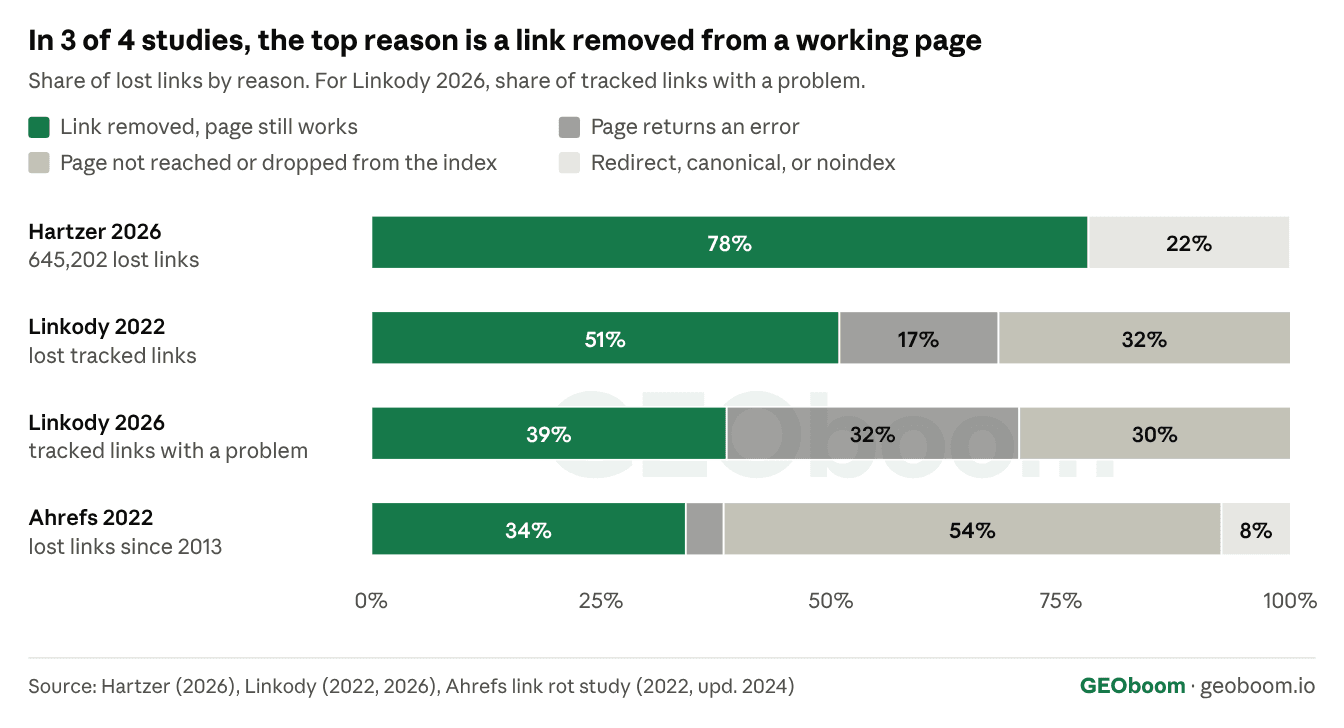
- The link was removed. The page still works, but your link is gone: 78% of Hartzer's lost links, 50.9% in Linkody's 2022 data, and 34.2% in Ahrefs'. Ahrefs lists the usual causes: a content refresh, a swap for another link, a company policy, or a competitor who stopped linking.
- The page is gone or can't be reached. In Linkody's 2022 data, 31.8% of losses were sites it could no longer read and 17.3% were HTTP errors, mostly 404 and 410. In Hartzer's data, this hardly happens: 4 of 645,202 lost links went to a 404, and 24 to a dead host.
- The page moved. A redirect, a new canonical, or a noindex tag takes the link out of the count. That's 7.5% of Ahrefs' lost links and 21.9% of Hartzer's.
- The link changed. A link that turns nofollow or gets a new anchor is still on the page. In Linkody's 2026 data, under 1% of tracked links had an anchor or rel change.
- The link was sold for a set time. In LinkDR's 2026 data, 24% of publishers who state their terms sell only time-limited links. Those links are meant to come down.
- The post was updated. Lists get rewritten, and an entry can drop out on the way. That's what happened in our case study on a dropped mention: GrowPad's spot in a "best GEO agencies for B2B SaaS" list disappeared when the publisher updated the post.
- The site died. Lilach Bullock checked 3,204 sites that accept guest posts in September 2026. 17.7% were dead or parked, and 29.4% in automotive.
A note on Ahrefs' biggest group. "Dropped" (47.7%) means the page fell out of Ahrefs' index, because it couldn't be crawled or indexed or the domain is gone. It doesn't always mean the page was deleted. Ahrefs' link reclamation guide says a dropped link is very likely still on the page. The study counts these links as rotted, so its 66.5% probably overstates real losses.
Some links are lost on your own side. The other site still links to you, but to a page of yours that's gone. Suff Digital found this on 97.6% of 500 business sites that rank in Google's top 10. On the median site it's 2% of backlinks, on a quarter of sites more than 22.6%, and 91% of those links are followed. After a platform switch, the median site has 22.7% of its linked URLs returning 404 or 410 (PageSpeed Matters, 659 sites). A 301 redirect to the closest live page brings that value back.
Which backlinks last longer?
Links from stronger sites. In Hartzer's data, a link from a Trust Flow 61+ site lasted a median of 9.2 years, close to four times the 2.4 years of a link from a Trust Flow 0 site.
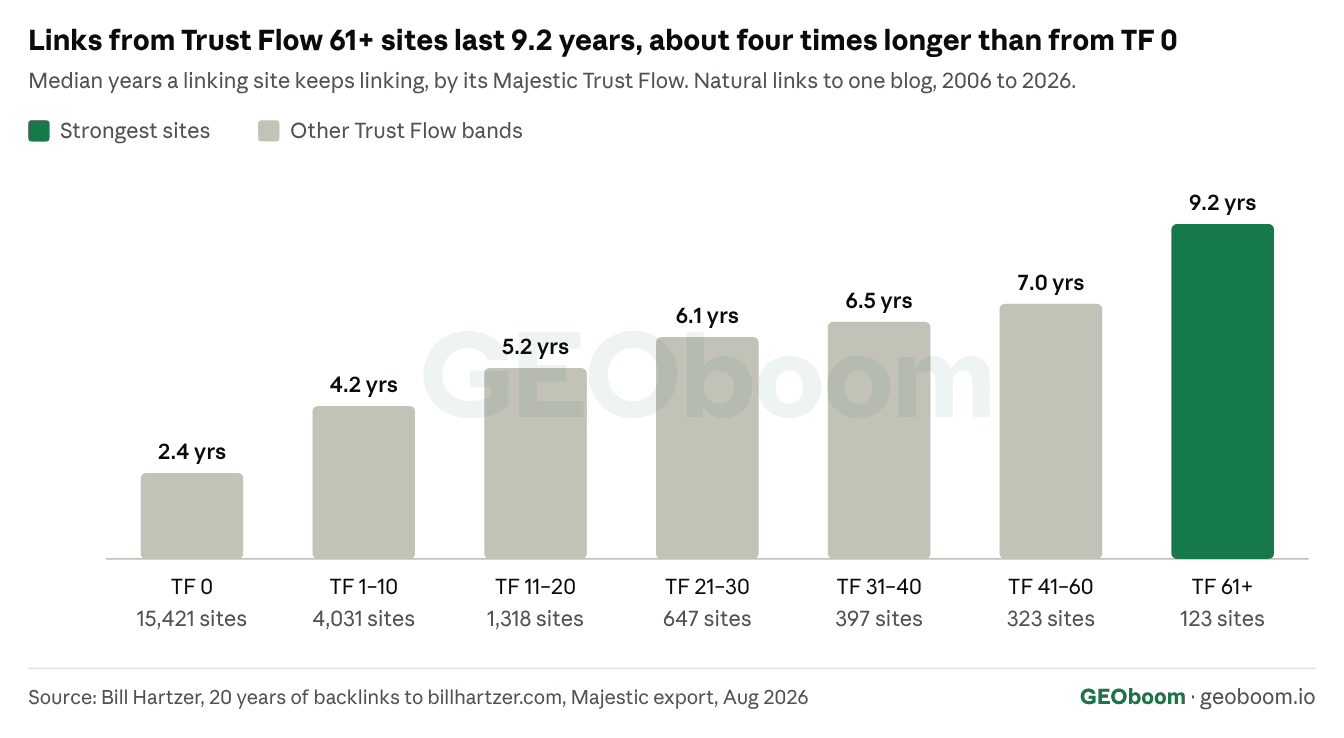
- Site authority. In Linkody's 2026 data, 33% of links on sites under DA 10 are still live, against about 70% on DA 30 to 49. Weak sites get abandoned, and the link goes with the page. In Hartzer's profile, 69.3% of all linking sites are Trust Flow 0: scrapers, aggregators, auto-made directories, and copied posts.
- Dofollow or nofollow. In Linkody's 2022 data, nofollow links had a survival rate 16% to 18% lower than dofollow links. The gap opens in the first year and then holds.
- The site you link to. Linkody's 2022 study also split links by the authority of the site they point at. Links to sites above DA 45 lost 10.9% in the first year, against 15.9% for DA 45 or below.
- Paid for a set time. A time-limited link lasts as long as the deal. One in four publishers who state their terms sell only those, per LinkDR.
Hartzer counts per linking site. Counted per link, his result flips for the top band, because a few large sites with sitewide links changed their templates and dropped tens of thousands of links in a day. That's why he prefers the per-site view, and we use it here.
What should you do about lost backlinks?
Check the links you built on a schedule, sort each loss by its cause, and ask for the ones worth getting back. In most datasets, the top reason is a link removed from a page that still works, so an email to the site can often bring it back.
- Check early and often. Losses cluster at the start: in Linkody's 2026 data, 21% of the links that died were gone within three months. For links you paid or worked for, check daily or weekly.
- Check the page, not just its status code. Hartzer's 404 checks would have caught 4 lost links in 20 years. Look at whether your link, anchor, and rel are still there, and for a list, your spot and the text about you.
- Sort losses by cause. Ahrefs' link reclamation guide gives a simple order. A removed link is often worth chasing. A deleted page sometimes is, if it looks like a mistake. Redirects and noindex usually aren't. Crawl errors usually clear on the next crawl, and a dropped page very likely still has your link.
- Fix your own dead pages. Find the pages on your site that return 404 or 410 but still have links, and 301 them to the closest live page. The linking sites don't need to change anything.
- Ask for the link back. Write to the person who placed it, reply in the same thread if you had a deal, and follow up if they're quiet. Linkody's 2022 study says a link you got or negotiated through link building is easy to reclaim. Ahrefs' guide makes the same point: when a link came from a deal, the other side is expected to keep its end of it.
Most backlink monitors stop at an alert, and the email is still on you. GEOboom checks every live placement it got for you once a day: the link, the anchor, nofollow, the text about you, and your spot in a list. In a mention exchange, it checks both sides. When something drops, GEOboom emails the publisher right away in the deal thread, tells you, and follows up if needed. No credits are spent on it.
That's how it went in our monitoring case study. GrowPad's #6 spot in a list on austinheaton.com dropped out when the post was updated. GEOboom found it in its daily check and wrote to the publisher on its own. The publisher replied in about an hour, and the spot was back the next day, with the same link. GrowPad spent zero minutes and $0 on it.
GEOboom watches the placements it got for you. To watch your whole backlink profile, pick a tool from our list of the best backlink monitoring tools. To replace links you can't get back, see the best link building tools.
Lost backlinks: FAQ
How long do backlinks last?
A few years on average, with wide spread. In Bill Hartzer's data, the median linking site stopped linking after just under three years. In Linkody's 2022 data, 56.6% of tracked links were still live after seven years.
What causes link rot?
Most often, someone removes the link from a page that's still online. Deleted pages, dead sites, redirects, and links sold for a set time make up most of the rest.
How can I check if I've lost backlinks?
Index tools like Ahrefs, Semrush, and Majestic show links they've seen go missing, and Ahrefs labels the reason for each. For links you built or paid for, a monitor that checks the page itself is more precise. See our list of the best backlink monitoring tools.
How often should I check my backlinks?
For links you built, at least weekly. Losses come early: in Linkody's 2026 data, 21% of the links that died were gone within three months.
What are broken backlinks?
Links from other sites that point at a page of yours that no longer exists. Suff Digital found them on 97.6% of 500 business sites in Google's top 10. A 301 redirect to the closest live page fixes them.
Do backlinks still matter in 2026?
Yes. In Ahrefs' study of 1 million search results, referring domains still correlate with rankings, at 0.255. For Google's AI Overviews, Ahrefs found that brand mentions on other sites correlate more strongly (0.664) than backlinks (0.218), so a lost mention counts too.
This article puts together nine published studies on lost links, checked November 11, 2026, plus one GEOboom case study. We opened each study, took the numbers as published, and noted who ran it and what it counts.
| Study | Who and when | What it counts | Sample | Who runs it |
|---|---|---|---|---|
| Link rot study | Patrick Stox, Ahrefs, April 29, 2022, updated February 2, 2024 | Every link in Ahrefs' index pointing at the sampled sites, since January 2013 | 2,062,173 sites | Sells an SEO toolset with lost-link reports |
| Link rot study | Aleksandar Dimovski, Linkody, October 4, 2022 | Links Linkody users track, checked every 24 hours, survival analysis | "Millions of links," exact count not given | Sells backlink monitoring |
| Link building statistics 2026 | François Mommens, Linkody, June 16, 2026, updated August 28, 2026 | Links users actively track, without competitor links, trials, and churned accounts | 865,000+ links; 139 accounts and 234,138 links for the account split | Sells backlink monitoring |
| 20 years of my own backlinks | Bill Hartzer, August 3, 2026 | Natural links to billhartzer.com from a Majestic export, survival per linking site | 1,301,839 links from 22,260 sites, about 2006 to 2026 | SEO consultant; one site |
| When online content disappears | Pew Research Center, May 17, 2024 | Whole web pages from Common Crawl, checked October 2023 | Just under 1 million pages, 2013 to 2023 | Nonprofit research center |
| Link building statistics 2026 | Ilias Ism, LinkDR, updated October 1, 2026 | Terms that publishers in its catalog state | 10,030 sites, 4,057 of them stating a term | Sells links |
| Guest posting statistics 2026 | Lilach Bullock, September 2026 | A live check of sites that accept guest posts | 3,204 domains | Consultant; runs a list of guest post sites |
| Backlinks to dead pages | Matt Suffoletto, Suff Digital, September 2026 | Backlinks pointing at dead pages on the linked site | 500 top-ranking and 249 small business sites | SEO agency |
| Backlinks lost in migration | Matt Suffoletto, PageSpeed Matters, October 19, 2026 | Linked URLs on sites that changed platform | 659 sites | Sells site speed work and migrations |
How we compared. We don't average studies that count different things. Charts show each study as published, with what it counts in the label. For the reasons chart, we grouped each study's categories into four: link removed from a working page; page returns an error; page not reached or dropped from the index; redirect, canonical, or noindex. Linkody's 2026 reasons are shown as shares of its links with a problem, which are 44% of everything it tracks. Hartzer's lifespans are converted from days to years. The FAQ also cites two Ahrefs studies on how links relate to rankings and to AI Overviews.
Notes on the sources. Linkody's 2022 study gives 82.36% still live after a year but calls the loss 17.37%; we use the survival figure. Its intro also rounds some numbers differently from its results; we use the results. Hartzer's data is one site with natural links, so it shows how natural links behave. Links you buy may behave differently.
Not included: Andy Zhao's "500 links over 2 years" (no method beyond the claim, and some columns are estimates); Broken Link Scan's 6.5 million links (links out of sites, not links in); the "34% of acquired backlinks are lost within 90 days" figure that circulates without a source; and the "15% to 40% within one to two years" in Google's AI Overview, credited to a page that doesn't contain it.
Who wrote it. Oleksii Andrusenko, Head of Marketing at GEOboom and CEO of GrowPad. Reviewed by Artur, CTO of GEOboom.
Disclosure. GEOboom is our product. It's link building and mention outreach software that also monitors the placements it gets. Every number here comes from other people's studies, except the monitoring case study, which comes from GEOboom. GrowPad, the client in it, is run by this article's author.
We plan to recheck these studies every quarter, next in February 2027. When GEOboom has enough monitoring data across clients, we'll add it here. The charts are free to use with a link to this page, and every figure above is in one file: lost-backlinks-statistics-2026.csv, under a CC BY 4.0 licence, with the study, its date, its sample and a link to the source on each row.
Related
- Link building statistics 2026: 117 stats from 23 studies
- How much do backlinks cost in 2026?
- 10 best backlink monitoring tools in 2026, compared
- 15 best link building tools in 2026, by category
- Case study: a dropped mention, restored the next day
- Case study: 64 exchange offers, $0 paid to publishers
This study is published by GEOboom, outreach software for getting your brand mentioned on the pages AI answers cite.