
- To rank in ChatGPT and Google's AI Overviews, get your brand named on the pages these answers already cite, and make your own pages easy to quote. Most of what AI says about a brand comes from other sites.
- Lists matter most. In Ahrefs' study of 26,283 ChatGPT source URLs (December 2025), "best X" blog lists were 43.8% of all page types. In AirOps' October 2025 report, 85% of brand mentions in AI answers came from external domains.
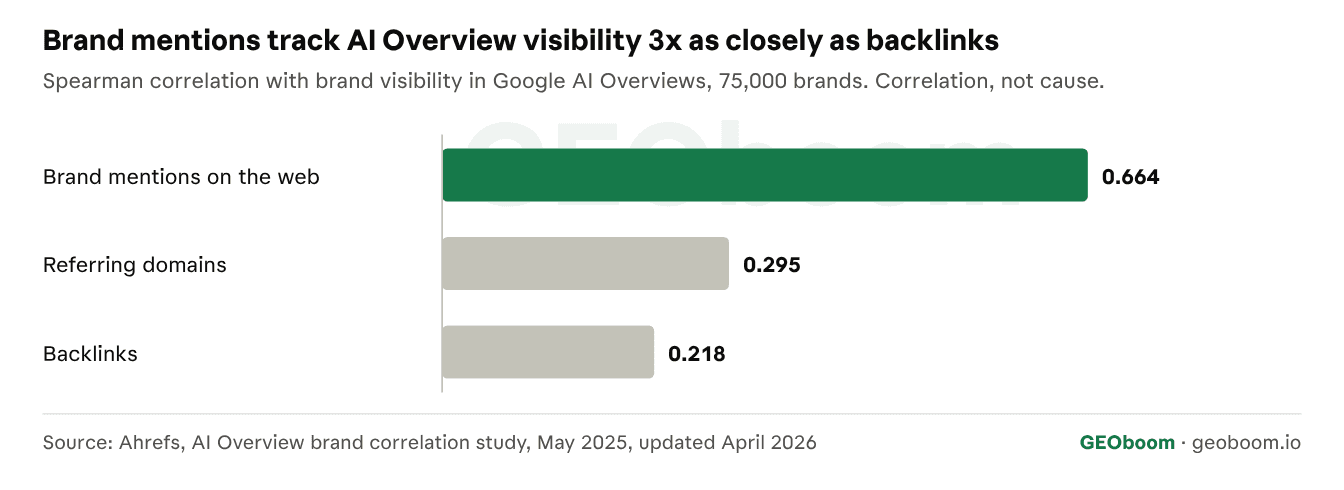
- Mentions count for more than links. Across 75,000 brands, Ahrefs found that brand mentions on the web correlate with AI Overview visibility at 0.664, and backlinks at 0.218. That's a correlation, not proof of cause.
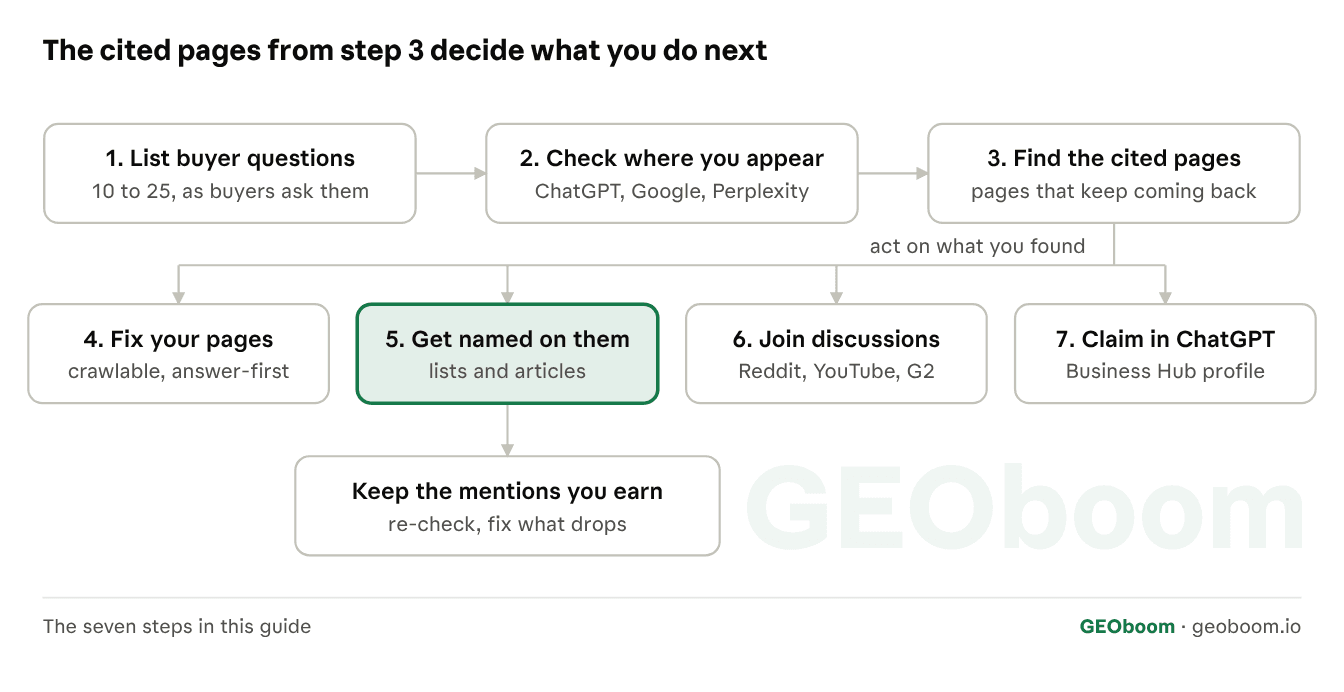
- The work takes seven steps: list your buyers' questions, check where you show up, find the cited pages, fix your own pages, get named on the cited pages, show up in discussions, and claim your business in ChatGPT. Then keep the mentions you earn.
- Data checked November 23, 2026. GEOboom is our product. It handles step 5, link building and mention outreach to cited pages, and we say where it helps and where it doesn't.
Mentioned vs cited: what ranking in ChatGPT means
A mention is when an AI answer names your brand. A citation is when the answer links to a page as its source. You can get one without the other, and the mention usually comes first.
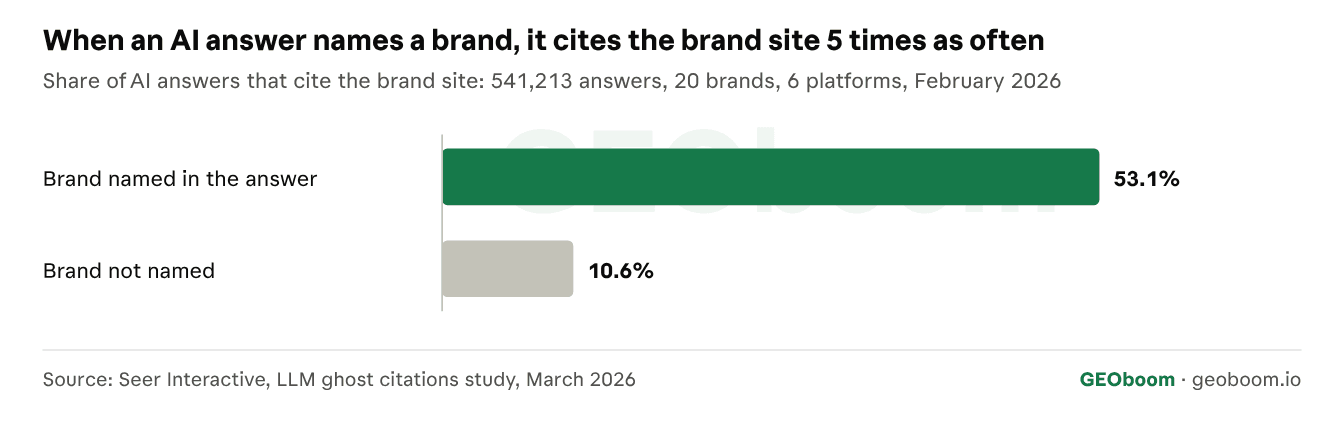
Seer Interactive looked at 541,213 AI answers for 20 brands on six platforms in February 2026. When an answer named a brand, it also cited that brand's own site much more often than when it didn't name it (chart below). Seer sells GEO services.
The platforms' own reports count links, not names. In OpenAI's Business Hub, a mention of an online business counts only when ChatGPT references its website, and the brand name alone doesn't count. Google's Search Console report for AI features counts an impression when a link to your page is shown. So a dashboard can miss an answer that names you without a link. Read the answers too, not just the reports.
Where ChatGPT and AI Overviews get their answers
Both run web searches, read the pages they find, and write an answer from them. So the pages they read decide which brands get named.
- ChatGPT finds pages through OpenAI's search crawler, OAI-SearchBot. OpenAI says that sites blocking it "will not be shown in ChatGPT search answers."
- AI Overviews use Google's own index. Google says a page only needs to be indexed and eligible to show with a snippet. It also uses "query fan-out," which runs several related searches, so it can cite pages from searches you never targeted.
Ranking in Google helps, but it isn't the whole story. In Ahrefs' March 2026 study of 863,000 search results, 37.9% of the pages AI Overviews cited also ranked in Google's top 10 for the same query. The other 62% didn't rank in the top 10 for that query.
Most of those pages belong to someone else. In AirOps' report, nearly 90% of third-party brand mentions came from listicles, comparisons, and reviews. Nearly 68% of brands showed up on only one AI platform. The study covered 500+ buying questions in ChatGPT, Claude, and Perplexity, and AirOps sells an AI content platform.
That's why mentions on other sites track AI visibility more closely than links do. Ahrefs, which sells the Brand Radar AI tracker, measured it across 75,000 brands:
The seven steps below follow from this. Steps 1 to 3 show you which pages matter, and steps 4 to 7 act on them.
Step 1: List the questions your buyers ask AI
Start with 10 to 25 questions a buyer would type into ChatGPT before choosing a product like yours. Write them the way people talk, not as keywords.
- Category questions: "best [category] for [audience]," "top [category] tools in 2026."
- Comparisons: "[competitor] alternatives," "[competitor] vs [competitor]."
- Problems: "how do I [job your product does] without [common pain]."
Pull the wording from sales calls, support tickets, Reddit threads, and the People Also Ask box in Google. Put buying questions first, because those are the answers that name brands and shape a shortlist.
Step 2: Check where you show up today
Ask each question in ChatGPT with search on, in Google (AI Overview and AI Mode), and in Perplexity. For each answer, note three things: are you named, in what position, and which pages does it cite? Answers change with time, location, and account, so run each question more than once.
For a quick first check, our free AI visibility checker shows whether ChatGPT and Google's AI Overviews name your brand and who they name instead. To repeat this every week without the manual work, use a tracker. We compared 12 of them in Best AI Visibility Tools.
Three free reports show the traffic side:
- Google Search Console has a report for Google's AI features. It counts an impression when a link to your page shows in an AI Overview or AI Mode, and it has no click data yet. Google started testing it in June 2026 with a small group of sites.
- Google Analytics 4 added an AI Assistant channel on May 13, 2026. It groups visits from ChatGPT, Gemini, Claude, and other assistants by referrer. Visits that arrive without a referrer still land in Direct, and clicks from AI Overviews count as Organic Search.
- ChatGPT Business Hub shows mentions and website clicks for the last 28 days once you claim your business (step 7).
Our AI referral traffic statistics collect what these numbers look like across studies.
Step 3: Find the pages AI already cites
For each question, collect the pages the answers cite. The same pages keep coming back across questions and engines, and those are your targets.
Our free AI citation tracker does this for up to five questions at a time. It puts each one live to ChatGPT, Google's AI Overview, Perplexity, and Gemini, then lists every cited page with how many answers cite it, which engines, and how strong the site is. Lists and articles you can pitch are picked out. It's free for five checks a day.
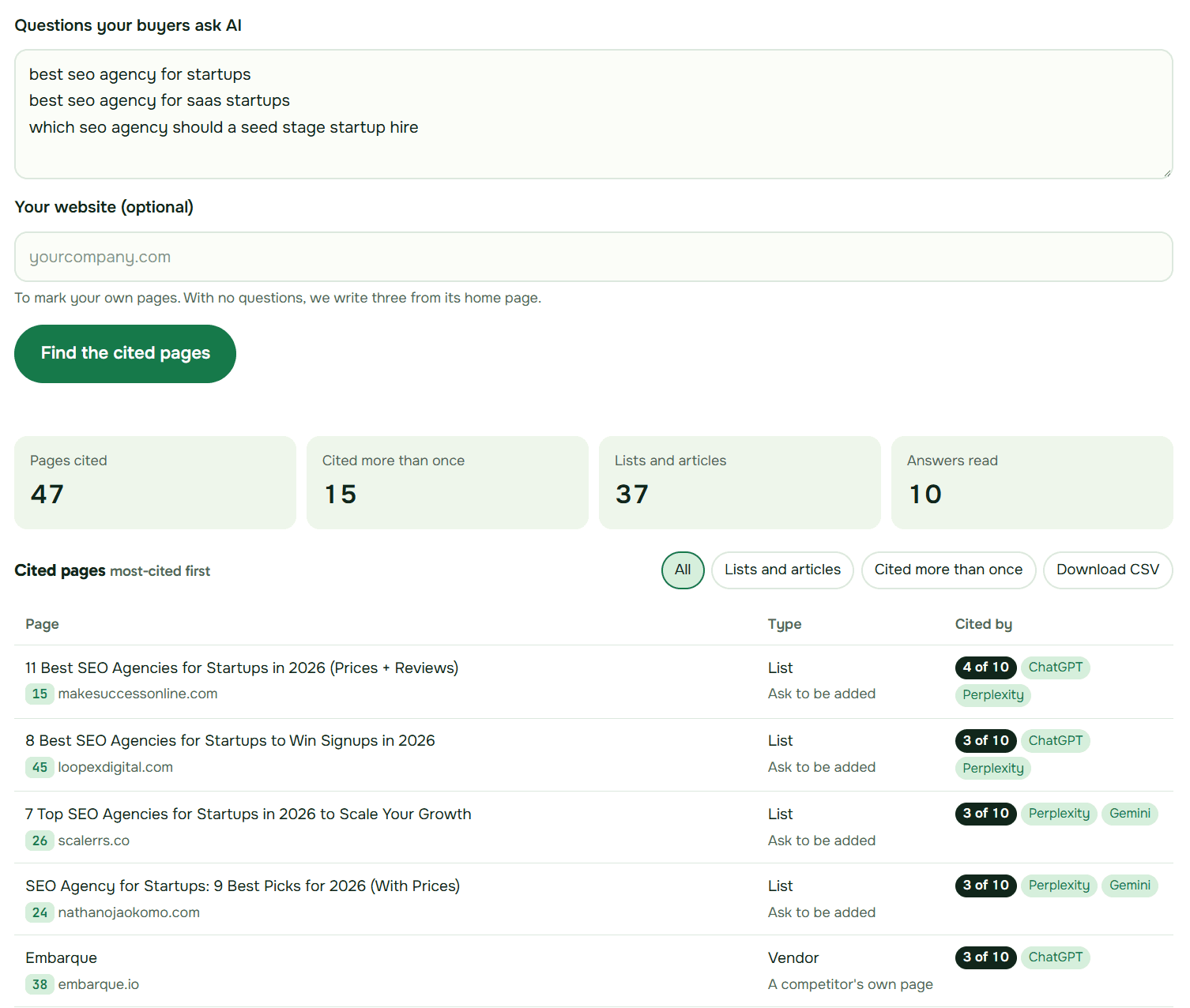
Then sort the pages by what you can do about them:
| Cited page | Example | What to do |
|---|---|---|
| Lists and comparisons on other sites | "9 best SEO agencies for startups" | Ask for a spot (step 5) |
| Articles and reviews on your topic | A guide that names three tools | Ask for a mention (step 5) |
| Discussions | Reddit threads, YouTube videos | Take part (step 6) |
| Review sites and directories | G2, Capterra, Clutch | Get listed and collect reviews (step 6) |
| Your own pages | Your pricing or comparison page | Make them easy to quote (step 4) |
| Competitors' own pages | A rival's "best tools" post that ranks itself first | Skip. Few will add a rival. |
Step 4: Make your own pages easy to quote
Your own site won't carry you alone, but it has to be readable and clear. Check these six things:
- Let the search crawlers in. Don't block OAI-SearchBot in robots.txt. OpenAI treats it separately from GPTBot, its training crawler, so you can block training and still show up in ChatGPT search.
- Keep your key pages in Google's index with snippets on. A nosnippet or data-nosnippet tag on the text that matters keeps it out of AI Overviews.
- Skip special AI files and markup for Google. Google says you don't need new machine-readable files, AI text files, or special schema to appear in its AI features.
- Answer first. Open each section with a one- or two-sentence answer, then add the detail.
- Say who you are in one sentence. Put what you do, for whom, and where on your home page, and use the same sentence on G2, LinkedIn, and other profiles.
- Build pages for buying questions. Pricing, "[you] vs [competitor]," alternatives, and use-case pages match the questions from step 1. Add your own numbers, like case studies or data, in plain text rather than in images.
Step 5: Get named on the pages AI cites
This is the step that moves AI answers most, because most brand mentions come from other sites. It's also the step most guides cover in one line: "get featured in best-of lists." Here's how to do it.
Lists change often, so a list that leaves you out today can add you next month. Of 1,100 blog lists Ahrefs checked, 79.1% were last updated in 2025, and 26% in the two months before the study.
Write to the person who edits the page. That's usually the author, the editor, or the content lead named on the page or on the site's About page; a free lookup finds the address. Check that the page is live and doesn't already mention you.
Ask for one thing per email. There are four common asks:
| Ask | When it fits | Watch out for |
|---|---|---|
| A spot in the list | A "best [category]" list leaves you out and you fit next to a tool on it | Say why you belong next to a specific entry |
| A one-line mention | An article covers your topic but isn't a ranked list | Offer to write the line so they can edit it |
| A mention exchange | You keep your own list that suits their readers | Google lists "excessive link exchanges" as link spam, so keep swaps few and on topic |
| A paid placement | The site only adds entries for a fee | Google requires a rel="sponsored" or rel="nofollow" tag on paid links |
The Google rules come from its spam policies, and a free check shows which attribute a live link carries. Our 12 outreach email templates cover each ask, two follow-ups, and replies to the site owner.
Expect most replies to ask for something. In GEOboom's case studies, 10% to 18% of contacted site owners replied. In Mentiohunt's outreach data (July 13 to November 10, 2026, 5,217 prospects), 52% of those who replied asked to be paid and 8% proposed an exchange. Mentiohunt sells outreach software and competes with GEOboom. Decide before you start what you'll pay and what you'll offer in return.
What one placement can do. GEOboom's GrowPad case study shows the full path:
- On August 27, 2026, one email went to LymLyt, a site with a list called "9 Best SEO Agencies for Startups in 2026." It proposed a position exchange.
- On September 14, 18 days later, GrowPad went live at #4 on that list. The publisher fee was $0.
- On October 23, Google's AI Overview for "best seo agency for startups" named GrowPad second of five agencies, with LymLyt's list among its sources.
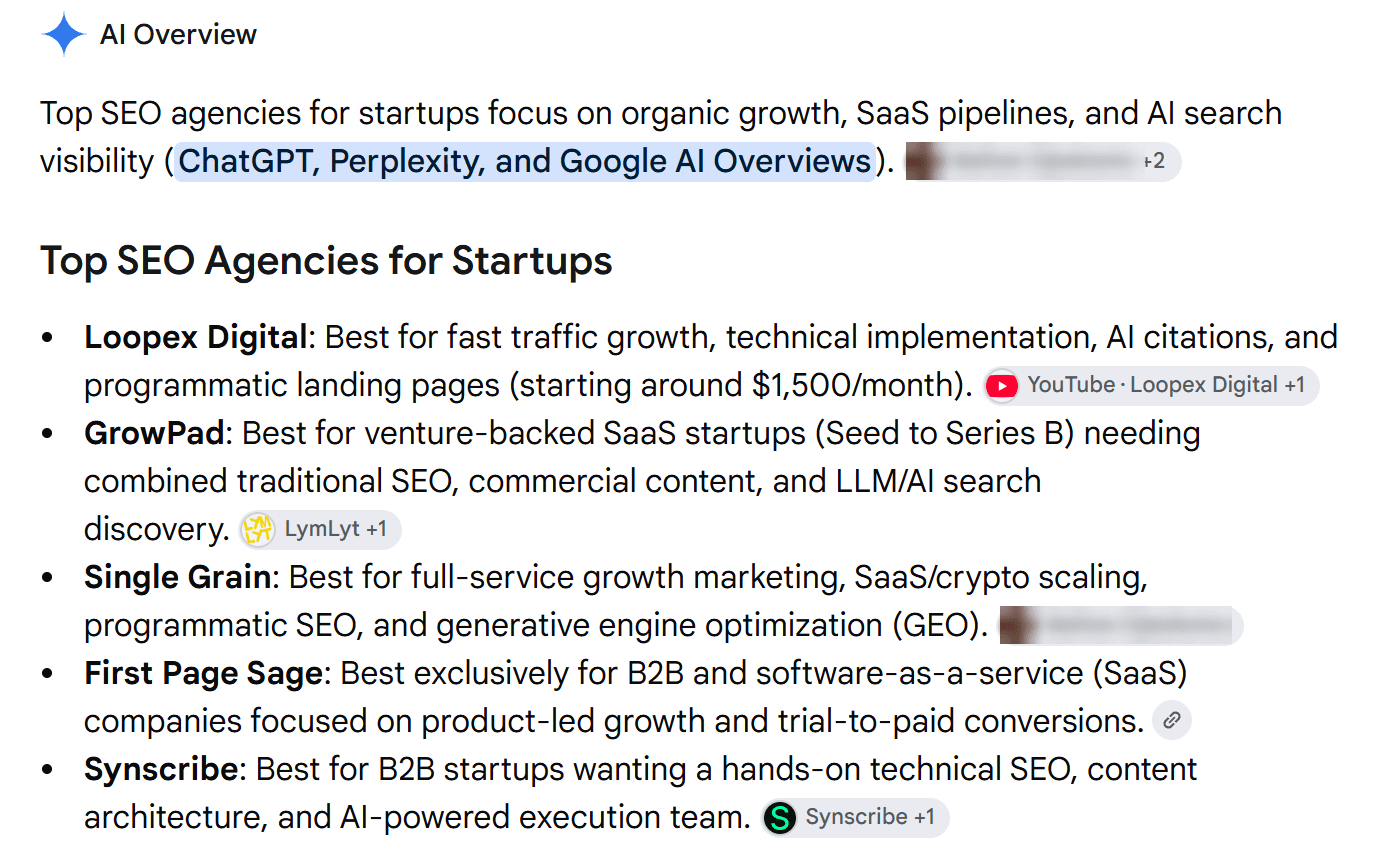
AI answers vary by time, location, and account, and one placement alone doesn't prove what caused a citation. GrowPad's CEO, Oleksii Andrusenko, wrote this guide and is also GEOboom's Head of Marketing.
Step 6: Show up where AI reads discussions
AI answers also draw on places where people talk about products. These take steady work, not one email.
- YouTube. In Ahrefs' study of 75,000 brands (December 2025), YouTube mentions had the strongest correlation with AI visibility of any factor they measured, about 0.737. It counts mentions of your brand anywhere on YouTube, so other channels' reviews and tutorials count too.
- Reddit and forums. Answer real questions in the threads AI already cites, from a named account, and say who you work for.
- Review sites. Get listed on G2, Capterra, or Clutch, and ask happy customers for reviews. Check in step 3 which of these your answers cite.
GEOboom doesn't do this part. It works with site owners by email, not with communities or video creators.
Step 7: Claim your business in ChatGPT
OpenAI's Business Hub lets you claim your business in ChatGPT. Its help page was last updated on November 21, 2026. You verify by phone, business email, a DNS record on your domain, or Shopify, then confirm your identity with Persona.
Once approved, you can:
- Update your website, description, category, logo, and delivery and return policies.
- Connect a product feed with prices and stock, if you sell products.
- See mentions, website clicks, and common topics from the last 28 days.
- Set up a business agent that answers customer questions, if you're an eligible US ecommerce or online service business.
Know the limits. OpenAI says claiming "doesn't guarantee increased visibility" and that advertising doesn't influence ChatGPT's answers. ChatGPT can still draw on other sources when it answers about you. So claim the profile to keep your facts right, and use steps 3 to 6 to get recommended.
Keep the mentions you earn
A mention isn't permanent. Site owners rewrite lists, drop entries, and move pages. In a 2022 Linkody study, about 1 in 6 links Linkody tracked were gone within a year. Our lost backlinks statistics collect more research on this.
Open each page where you're named every few weeks, or use a monitor. Check three things: your brand is still there, it holds the same spot in the list, and the link (if any) still works. Most monitors stop at an alert. If a mention drops, write to the site owner in the same email thread where you agreed on it.
GEOboom's monitoring case study shows this in practice. A GrowPad mention fell out when the publisher updated a post. GEOboom found it, wrote to the publisher itself, got a reply in about an hour, and the mention was back the next day.
How long it takes
Plan in weeks to months, not days. Nobody can promise a date, because AI answers change and you don't control the pages they read. Here's how long each part takes:
| Change | How long it takes to show |
|---|---|
| Unblocking OAI-SearchBot in robots.txt | About 24 hours, per OpenAI |
| Changing snippet controls for Google | Days to months, until Google recrawls the page, per Google |
| Getting onto a cited list | 18 days from the first email to a live spot in the GrowPad case |
| Showing up in the AI answer | The GrowPad AI Overview was captured about five weeks after the spot went live |
| Updating your ChatGPT Business Hub profile | OpenAI reviews changes first, and they "can take time to appear" |
Steps 1 to 4 are work on your side, so you set their pace. Outreach takes longer, because you wait on other people's update schedules.
How GEOboom fits
GEOboom is our link building and mention outreach tool. It runs steps 3 and 5 and the monitoring after them, so your part is deciding on each offer. Here's what it does:
- Finds the cited pages. It takes them from your AI visibility tracker (including SE Ranking), from keywords and prompts you give it, or from your own URL list.
- Filters them. It reads each page against your site and drops off-topic pages, competitor sites, pages that already mention you, and link farms.
- Finds the contacts. It looks for the editor, author, or content lead and has verified contacts at over 90% of sites.
- Sends the emails. Personal first emails and follow-ups go out from mailboxes GEOboom sets up and warms for you. The first emails go out the day your account opens.
- Brings back the offers. Each reply comes with the site's numbers, a drafted answer, and a blurb in the list's style. You approve or skip each offer.
- Watches the result. It checks every live placement once a day and writes to the site owner itself if your mention drops.
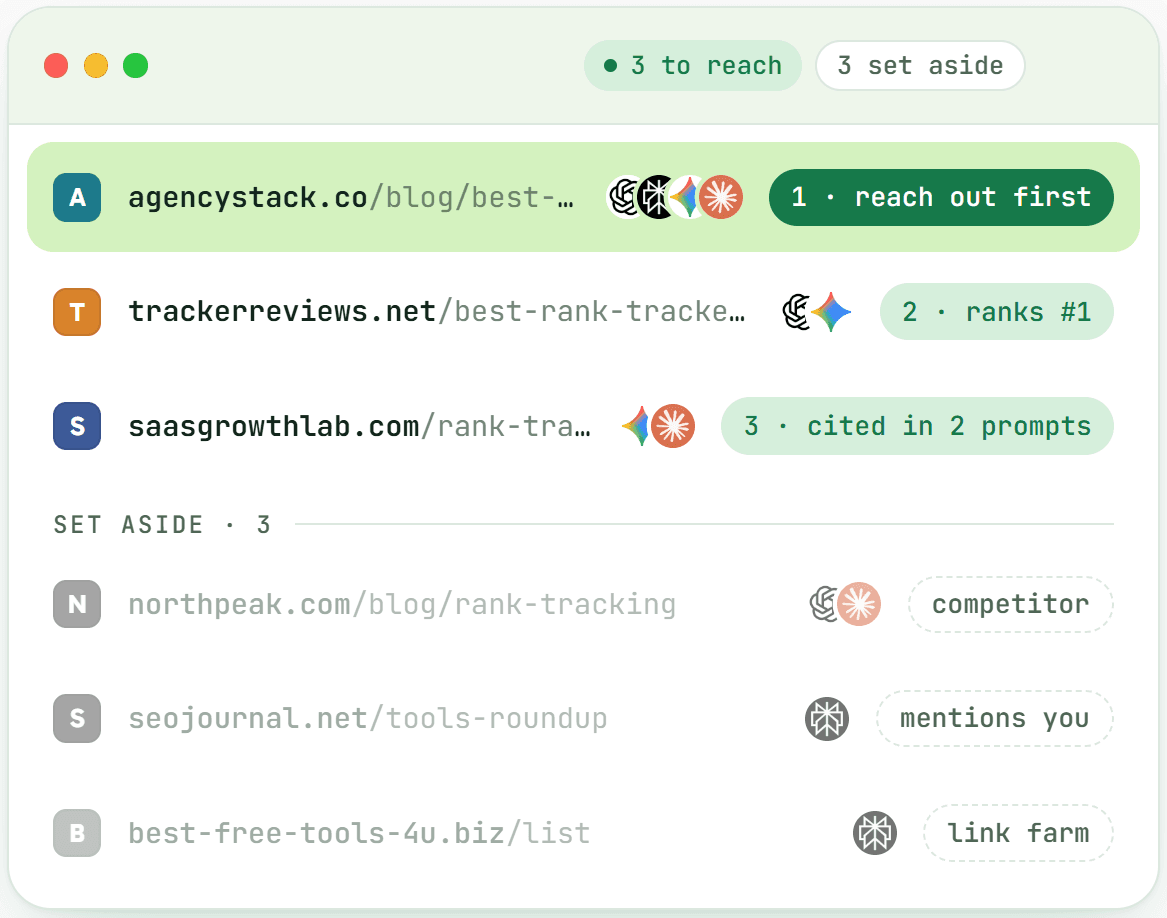
The price is from $150 a month, 2–8 placements a month, and a free trial is available on request. Publisher fees are separate: you pay sites directly, GEOboom takes no cut, and exchanges cost nothing. GEOboom works with English-language sites. It doesn't do digital PR, Reddit, YouTube, or changes to your own site, and it isn't a marketplace or a done-for-you service.
You can also run it from Claude, ChatGPT, or Cursor through the GEOboom MCP server. See how it works at geoboom.io.
Ranking in ChatGPT: FAQ
How do I get my business to show up in AI searches?
Find the pages AI answers already cite for your buyers' questions, and get your brand named on them. Then make your own pages easy to quote, and keep the mentions you earn. The seven steps above cover each part.
How do I list my business on ChatGPT?
Claim it in ChatGPT Business Hub. You verify your link to the business, confirm your identity, and then manage your profile. A claimed profile keeps your facts right, but OpenAI says it doesn't guarantee more visibility.
How do I get indexed in ChatGPT?
Allow OAI-SearchBot in your robots.txt, because OpenAI says sites that block it won't appear in ChatGPT search answers. Then make sure your pages can be found in web search.
Can I pay ChatGPT to mention my brand?
No. OpenAI says advertising doesn't influence ChatGPT's independent answers. You can pay a site for a spot on a list that AI cites, but Google requires paid links to carry a rel="sponsored" or rel="nofollow" tag.
Does ranking in Google help you rank in ChatGPT and AI Overviews?
It helps, but it's not enough. In Ahrefs' March 2026 data, 37.9% of the pages AI Overviews cited ranked in Google's top 10 for the same query. Mentions on other sites track AI visibility more closely than backlinks do.
How long does it take to get mentioned in ChatGPT?
Weeks to months. In GEOboom's GrowPad case, it took 18 days from the first email to a live spot on a cited list. Google's AI Overview named GrowPad when it was checked about five weeks later.
How this guide was prepared
We checked Google's US results for six searches on this topic on November 23, 2026, to see what existing guides cover and what they leave out. We opened the source for every figure in this guide and checked it the same day. Ahrefs sells the Brand Radar AI tracker, AirOps sells an AI content platform, Seer Interactive sells GEO services, and Mentiohunt competes with GEOboom, so we say so where we cite them. The GrowPad example comes from a published GEOboom case study, and GrowPad's CEO wrote this guide. GEOboom is our product.
Related
- Outreach Email Templates for Listicle Inclusion and Mention Requests
- Best AI Visibility Tools
- Brand Mentions vs Backlinks in AI Search
- AI Referral Traffic Statistics
This guide is written by GEOboom, outreach software for getting your brand mentioned on the pages AI answers cite.